Replaces Prod. #: ALX-350-001
- Cell-permeable, potent, reversile, and rapid activator of adenylate cyclase
- Compound used to study the role of cAMP as secondary messenger
- Highly cited
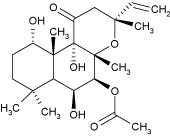
Forskolin is naturally produced by the Coleus plant, Coleus forskohlii. Forskolin activates adenylate cyclase by directly interacting with the catalytic unit of the enzyme leading to an increase in the intracellular concentration of cAMP. Forskolin is a widely used tool for the investigation of the role of cAMP as a second messenger with a broad range of potential therapeutic applications. Forskolin is a ionotropic agent and vasodilator. Forskolin also reduces platelet aggregation in a dose-dependent manner, inhibits ion channels by a mechanism that does not involve cAMP, inhibits nicotinic acetylcholine receptors and induces neuronal differentiation in stem cells and several neuroblastoma.
Product Details
| Alternative Name: | Coleonol, Colforsin |
| |
| Formula: | C22H34O7 |
| |
| MW: | 410.5 |
| |
| Source: | Isolated from Coleus forskohlii. |
| |
| CAS: | 66575-29-9 |
| |
| MI: | 14: 2476 |
| |
| Purity: | ≥97% (HPLC, TLC) |
| |
| Appearance: | White solid. |
| |
| Solubility: | Soluble in anhydrous DMSO (5mg/ml), 100% ethanol (6mg/ml), or ethyl acetate (10mg/ml). DMSO is the recommended solvent for activation of cAMP. |
| |
| Shipping: | Ambient Temperature |
| |
| Long Term Storage: | -20°C |
| |
| Use/Stability: | Stock solutions in DMSO are stable for up to 4 months when stored at +4°C. Do not dissolve in ethanol, which inhibits forskolin activation of adenylate cyclase. |
| |
| Regulatory Status: | RUO - Research Use Only |
| |
Please mouse over
Product Literature References
Aβ-induced mitochondrial dysfunction in neural progenitors controls KDM5A to influence neuronal differentiation: D.K. Kim, et al.; Exp. Mol. Med.
54, 1461 (2022),
Abstract;
Full Text
Role of Roflumilast combined with ESHAP chemotherapy in relapsed/refractory patients with diffuse large B-cell lymphoma: D.Y. Kim, et al.; Cancer Res. Treat.
54, 301 (2022),
Abstract;
Full Text
Activation of GPR37 in macrophages confers protection against infection-induced sepsis and pain-like behaviour in mice: S. Bang, et al.; Nat. Commun.
12, 1704 (2021),
Abstract;
Full Text
Selective suppression and recall of long-term memories in Drosophila: D. Siegenthaler, et al.; Sci. Rep.
17, e3000400 (2019),
Abstract;
Full Text
Functional characterization reveals that zebrafish CFTR prefers to occupy closed channel conformations: J. Zhang, et al.; PLoS One
13, e0209862 (2018),
Abstract;
Full Text
Escherichia coli O157: H7 suppresses host autophagy and promotes epithelial adhesion via Tir-mediated and cAMP-independent activation of protein kinase A: Y. Xue, et al.; Cell Death Discov.
3, 17055 (2017),
Abstract;
Cilostamide and forskolin treatment during pre-IVM improves preimplantation development of cloned embryos by influencing meiotic progression and gap junction communication in pigs: B. Park, et al.; Theriogenology
86, 757 (2016),
Abstract;
Phosphoinositide 3-kinase γ ties chemoattractant- and adrenergic control of microglial motility: N. Schneble, et al.; Mol. Cell. Neurosci.
78, 1 (2016),
Abstract;
Serum Amyloid A3 Secreted by Preosteoclasts Inhibits Parathyroid Hormone-Stimulated cAMP Signaling in Murine Osteoblasts: S. Choudhary, et al. ; J. Biol. Chem.
291, 3882 (2016),
Application(s): Cell culture,
Abstract;
Full Text
cAMP and EPAC Signaling Functionally Replace OCT4 During Induced Pluripotent Stem Cell Reprogramming: A.L. Fritz, et al.; Mol. Ther.
23, 952 (2015),
Abstract;
Full Text
Cross-talk between PKA-Cβ and p65 mediates synergistic induction of PDE4B by roflumilast and NTHi: S. Susuki-Miyata, et al.; PNAS
112, E1800 (2015),
Application(s): Pretreatment,
Abstract;
Full Text
Different methods for inducing adipose-derived stem cells to differentiate into Schwann-like cells: S. Gao, et al.; Arch. Med. Sci.
11, 886 (2015),
Application(s): Cell Induction,
Abstract;
Full Text
Hydrogen peroxide stimulation of CFTR reveals an Epac-mediated, soluble AC-dependent cAMP amplification pathway common to GPCR signalling: P. Ivonnet, et al.; Br. J. Pharmacol.
172, 173 (2015),
Abstract;
Full Text
Mechanism of Toona sinensis-stimulated adrenal steroidogenesis in primary rat adrenal cells: Y.C. Chen, et al.; J. Funct. Foods 14, 318 (2015), Application(s): Cell Culture,
The mixed-action delta/mu opioid agonst MMP-2200 does not produce conditioned place preference but does maintain drug self-administration in rats, and induces in vitro markers of tolerance and dependence: G.W. Stevenson, et al.; Pharmacol. Biochem. Behav.
132, 49 (2015),
Application(s): Cell Culture,
Abstract;
CXCL4L1 and CXCL4 signaling in human lymphatic and microvascular endothelial cells and activated lymphocytes: involvement of mitogen-activated protein (MAP) kinases, Src and p70S6 kinase: K. Van Raemdonck, et al.; Angiogenesis
17, 631 (2014),
Abstract;
Identification of plumericin as a potent new inhibitor of the NF-κB pathway with anti-inflammatory activity in vitro and in vivo: N. Fakhrudin, et al.; Br. J. Pharmacol.
171, 1676 (2014),
Abstract;
Full Text
Phosphorylation of ABCB4 impacts its function: insights from disease-causing mutations: J. Gautherot, et al.; Hepatology
60, 610 (2014),
Abstract;
Adenomatous polyposis coli regulates oligodendroglial development: J. Lang, et al.; J. Neurosci.
33, 3113 (2013),
Abstract;
Full Text
Effect of forskolin on the expression of claudin-5 in human trophoblast BeWo cells: M. Harada, et al.; Pharmazie
62, 291 (2007),
Abstract;
Forskolin as a tool for examining adenylyl cyclase expression, regulation, and G protein signaling: P.A. Insel & R.S. Ostrom; Cell Mol. Neurobiol.
23, 305 (2003), Review,
Abstract;
The effect of forskolin on blood flow, platelet metabolism, aggregation and ATP release: J.T. Christenson, et al.; Vasa
24, 56 (1995),
Abstract;
Forskolin acts as a noncompetitive inhibitor of nicotinic acetylcholine receptors: M.L. Aylwin & M.M. White; Mol. Pharmacol.
41, 908 (1992),
Abstract;
Effect of forskolin on cytosolic Ca++ level and contraction in vascular smooth muscle: A. Abe & H. Karaki; J. Pharmacol. Exp. Ther.
249, 895 (1989),
Abstract;
Forskolin: a specific stimulator of adenylyl cyclase or a diterpene with multiple sites of action?: A. Laurenza, et al.; Trends Pharmacol. Sci.
10, 442 (1989), Review,
Abstract;
Forskolin: its biological and chemical properties: K.B. Seamon & J.W. Daly; Adv. Cyclic Nucleotide Protein Phosphorylation Res.
20, 1 (1986),
Abstract;
Use of forskolin to study the relationship between cyclic AMP formation and bone resorption in vitro: U.H. Lerner, et al.; Biochem. J.
240, 529 (1986),
Abstract;
Forskolin and antidiuretic hormone stimulate a Ca2+-activated K+ channel in cultured kidney cells: S.E. Guggino, et al.; Am. J. Physiol.
249, F448 (1985),
Abstract;
Pharmacology and inotropic potential of forskolin in the human heart: M.R. Bristow, et al.; J. Clin. Invest.
74, 212 (1984),
Abstract;
Forskolin, an activator of adenylate cyclase, increases CA2+-dependent electrical activity induced by glucose in mouse pancreatic B cells: J.C. Henquin, et al.; Endocrinology
112, 2218 (1983),
Abstract;
Forskolin: a labdane diterpenoid with antihypertensive, positive inotropic, platelet aggregation inhibitory, and adenylate cyclase activating properties: N.J. de Souza, et al.; Med. Res. Rev.
3, 201 (1983),
Abstract;
Inhibition of forskolin-activated adenylate cyclase by ethanol and other solvents: R. D. Huang, et al.; J. Cyclic Nucleotide Res.
8, 385 (1982),
Abstract;
Forskolin: a unique diterpene activator of cyclic AMP-generating systems: K.B. Seamon & J.W. Daly; J. Cyclic Nucleotide Res.
7, 201 (1981), Review,
Abstract;
Related Products