You are logged on as Guest.
RegisterLoginShopping cart (Empty)
 United States

MegaAPRIL™ (soluble) (human), (recombinant)

 
ALX-522-035-3010 3x10 µg 587.00 USD
 

Product Specification

Alternative Name:APRIL:ACRP30headless, TNFSF 13:ACRP30headless, A-proliferation-inducing ligand:ACRP30headless, CD256:ACRP30headless
 
Concentration:0.1mg/ml after reconstitution.
 
Endotoxin Content:<0.1EU/µg purified protein (LAL test; Bio Whittaker).
 
MW:~34kDa (SDS-PAGE).
 
Purity:≥95% (SDS-PAGE)
 
Formulation:Lyophilized. Contains PBS.
 
Biological Activity:Stimulates proliferation of serum-starved NIH 3T3 cells. Stimulates B cell proliferation.
 
Source/Host:Produced in HEK 293 cells. The extracellular domain of human APRIL (aa 88-233) is fused at the N-terminus to human ACRP30headless (aa 16-108) and a FLAG®-tag.
 
Reconstitution:Reconstitute with 100µl sterile water.
 
Specificity:Binds to human and mouse BCMA and TACI. Binds to proteoglycans.
 
Long Term Storage:-20°C
 
Use/Stability:PBS containing at least 0.1% BSA should be used for further dilutions. Stable for at least 6 months after receipt when stored at -20°C.
 
Handling:After reconstitution, prepare aliquots and store at -20°C.
Avoid freeze/thaw cycles.
 
Background / Technical Information:

UniProt ID O75888: APRIL (human)
AfCS Signaling Gateway ID A000305: APRIL (mouse)

FLAG is a registered trademark of Sigma-Aldrich Co.

 
522-035
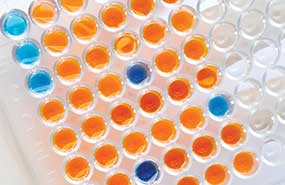
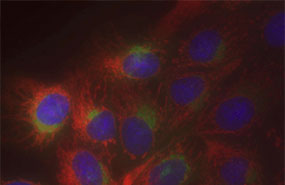
Figure: MegaAPRIL™, Soluble (human) (rec.) induces Swiss NIH-3T3 cells to proliferate in low serum conditions.Method: Proliferation assay: 5000 Swiss NIH3T3 cells were plated per well of a 96-well plate and rested overnight. Cells were then washed once in PBS buffer and starved in medium with 0% FCS for 24 hours. After the starvation period, medium containing 0.2% FCS (left column) or containing 0.2% FCS and 20ng/ml of MegaAPRIL™ (right column) was added to the cells. Cells were then cultured for 48 hours and cell viability was determined using a PMS/MTS-based cell proliferation assay kit.
Please mouse over
522-035

Product Literature References

BAFF and APRIL support chronic lymphocytic leukemia B-cell survival through activation of the canonical NF-kappaB pathway: T. Endo, et al.; Blood 109, 703 (2007), Abstract; Full Text
TACI regulates IgA production by APRIL in collaboration with HSPG: D. Sakurai, et al.; Blood 109 , 2961 (2007), Abstract;
APRIL and BAFF promote increased viability of replicating human B2 cells via mechanism involving cyclooxygenase 2: P.K. Mongini, et al.; J. Immunol. 176, 6736 (2006), Abstract; Full Text
BAFF regulates B cell survival by downregulating the BH3-only family member Bim via the ERK pathway: A. Craxton, et al.; J. Exp. Med. 202, 1363 (2005), Abstract;
Lymphoma B cells evade apoptosis through the TNF family members BAFF/BLyS and APRIL: B. He, et al.; J. Immunol. 172, 3268 (2004), Abstract; Full Text
Potential role of APRIL as autocrine growth factor for megakaryocytopoiesis: D. Bonci, et al.; Blood 104, 3169 (2004), Abstract; Full Text
APRIL modulates B and T cell immunity: J.V. Stein, et al.; J. Clin. Invest. 109, 1587 (2002), Abstract; Full Text
DCs induce CD40-independent immunoglobulin class switching through BLyS and APRIL: M.B. Litinskiy, et al.; Nat. Immunol. 3, 822 (2002), Abstract;

General Literature References

B-cell maturation protein, which binds the tumor necrosis factor family members BAFF and APRIL, is dispensable for humoral immune responses: S. Xu & K.P. Lam; Mol. Cell. Biol. 21, 4067 (2001), Abstract;
A soluble form of B cell maturation antigen, a receptor for the tumor necrosis factor family member APRIL, inhibits tumor cell growth: P. Rennert, et al.; J. Exp. Med. 192, 1677 (2000), Abstract;
APRIL and TALL-I and receptors BCMA and TACI: system for regulating humoral immunity: G. Yu, et al.; Nat. Immunol. 1, 252 (2000), Abstract;
Interaction of the TNF homologues BLyS and APRIL with the TNF receptor homologues BCMA and TACI: S.A. Marsters, et al.; Curr. Biol. 10, 785 (2000), Abstract;
Tumor necrosis factor (TNF) receptor superfamily member TACI is a high affinity receptor for TNF family members APRIL and BLyS: Y. Wu, et al.; J. Biol. Chem. 275, 35478 (2000), Abstract;
APRIL, a new ligand of the tumor necrosis factor family, stimulates tumor cell growth: M. Hahne, et al.; J. Exp. Med. 188, 1185 (1998), Abstract;

Product Toolbox

PRODUCT RESOURCES

Datasheet 
MSDS 

RELATED PRODUCTS

By catalog section:
By biological activity:
APRIL Recombinant protein

PRODUCT SUPPORT

Technical Service
Bulk Quantity Quote
Customer Service
©2010 Enzo Life Sciences, Inc.,