Replaces Prod. #: BML-CC206
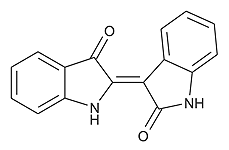
Inhibitor of cyclin-dependent kinases (CDK1/cyclin B (IC50=10µM), CDK2/cyclin A (IC50=2.2µM), CDK2/cyclin E (IC50=7.5µM), CDK4/cyclin D1 (IC50=12µM), CDK5/p35 (IC50=5.5µM)) and of GSK-3β (IC50=600nM). Inhibits inflammatory reaction in delayed-type hypersensitivity in mice. Ligand of human aryl hydrocarbon receptor. Exhibits anti-cancer activity.
Product Details
| Formula: | C16H10N2O2 |
| |
| MW: | 262.3 |
| |
| Source: | Synthetic. |
| |
| CAS: | 479-41-4 |
| |
| Purity: | ≥97% (HPLC) |
| |
| Appearance: | Purple powder. |
| |
| Solubility: | Soluble in DMSO (10mg/ml) or methanol (0.3mg/ml); sparingly soluble in aqueous buffers (12.5µg/ml). |
| |
| Shipping: | Ambient Temperature |
| |
| Long Term Storage: | +4°C |
| |
| Use/Stability: | Stable for at least 2 years when stored at +4°C in the dark. Stock solutions should be stored in the dark and used within 1 month. |
| |
| Handling: | Protect from light. Keep cool and dry. |
| |
| Scientific Background: | Indirubin is derived from various natural sources, such as Indigofera indica, Isatis tinctoria and I. indigotica by fermentation, oxidation and the presence of light as a by product of indigo formation. Indirubin is also present in human urine and fetal bovine serum. Preclinical studies of indirubin confirmed its anti-tumor activity. Efficacy against chronic myelocytic leukemia was demonstrated in clinical trials in China. |
| |
| Regulatory Status: | RUO - Research Use Only |
| |
Please mouse over
Product Literature References
The role of DNA-binding and ARNT dimerization on the nucleo-cytoplasmic translocation of the aryl hydrocarbon receptor: R. Haider, et al.; Sci. Rep.
11, 18194 (2021),
Abstract;
Indirubin enhances tumor necrosis factor-induced apoptosis through modulation of nuclear factor-kappa B signaling pathway: G. Sethi, et al.; J. Biol. Chem.
281, 23425 (2006),
Abstract;
Molecular mechanisms of indirubin and its derivatives: novel anticancer molecules with their origin in traditional Chinese phytomedicine: G. Eisenbrand, et al.; J. Cancer Res. Clin. Oncol.
130, 627 (2004),
Abstract;
Indirubin and indigo are potent aryl hydrocarbon receptor ligands present in human urine: J. Adachi, et al.; J. Biol. Chem.
276, 31475 (2001),
Abstract;
Full Text
Indirubins inhibit glycogen synthase kinase-3 beta and CDK5/p25, two protein kinases involved in abnormal tau phosphorylation in Alzheimer’s disease. A property common to most cyclin-dependent kinase inhibitors?: S. Leclerc, et al.; J. Biol. Chem.
276, 251 (2001),
Abstract;
Full Text
Indirubin inhibits inflammatory reactions in delayed-type hypersensitivity: T. Kunikata, et al.; Eur. J. Pharmacol.
410, 93 (2000),
Abstract;
Indirubin, the active constituent of a Chinese antileukaemia medicine, inhibits cyclin-dependent kinases: R. Hoessel, et al.; Nature Cell Biol.
1, 60 (1999),
Abstract;
Related Products