Replaces Prod. #: ALX-260-092
-
High purity peptide
-
Most economical MG-132 on the market
-
Widely cited for more than two decades
-
Well-characterized with a variety of applications
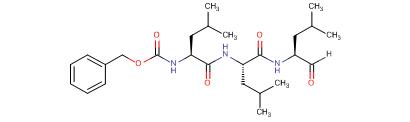
MG-132 is a potent, cell permeable and selective proteasome inhibitor (Ki = 4nM).1 It inhibits NF-κB activation by preventing IκB degradation (IC50 = 3μM). The peptide blocks degradation of short-lived proteins, which in turn induces HSP and ER chaperone expression, leading to thermotolerance (1μM MG-132, 2 h.). It also stimulates neurite outgrowth in PC12 cells (20nM optimal). The peptide has also been reported to increase the survival rate of mesenchymal stem cells following their transplantation. IC50’s for inhibition of Suc-LLVY-AMC and Z-LLL-AMC cleaving activities of proteasome were 0.85 and 0.1μM respectively. The ubiquitin-proteasome system (UPS) and autophagy serve as two complementary, reciprocally regulated protein degradation systems, thus blockade of UPS by MG-132 activates autophagy.
Product Details
| Alternative Name: | Z-LLL-CHO |
| |
| Sequence: | Z-Leu-Leu-Leu-CHO |
| |
| Formula: | C26H41N3O5 |
| |
| MW: | 475.6 |
| |
| CAS: | 133407-82-6 |
| |
| Purity: | ≥98% |
| |
| Appearance: | White solid. |
| |
| Solubility: | Soluble in DMSO (25mg/ml) or 100% ethanol (25mg/ml). |
| |
| Shipping: | Dry Ice |
| |
| Long Term Storage: | -80°C |
| |
| Use/Stability: | Solutions are stable for up to one week if stored at -20°C. Solutions are stable for up to two months if stored at -80°C. |
| |
| Technical Info/Product Notes: | Replacement for ADI-HPK-116 |
| |
| Regulatory Status: | RUO - Research Use Only |
| |
Please mouse over
Product Literature References
14-3-3 proteins regulate cullin 7-mediated Eag1 degradation: C.H. Hsieh, et al.; Cell Biosci.
13, 18 (2023),
Abstract;
ARD1 stabilizes NRF2 through direct interaction and promotes colon cancer progression: X. Gang, et al.; Life Sci.
313, 121217 (2023),
Abstract;
Cytokine-Mediated Degradation of the Transcription Factor ERG Impacts the Pulmonary Vascular Response to Systemic Inflammatory Challenge: C.M. Schafer, et al.; bioRxiv 2023.02.08.527788 (2023),
Abstract;
Mono-ADP-ribosylation by PARP10 inhibits Chikungunya virus nsP2 proteolytic activity and viral replication: S. Krieg, et al.; Cell. Mol. Life Sci.
80, 72 (2023),
Abstract;
SPATA2 restricts OTULIN-dependent LUBAC activity independently of CYLD: L. Griewahn, et al.; Cell Rep.
42, 111961 (2023),
Abstract;
SPY1 inhibits neuronal ferroptosis in amyotrophic lateral sclerosis by reducing lipid peroxidation through regulation of GCH1 and TFR1: D. Wang, et al.; Cell Death Differ.
30, 369 (2023),
Abstract;
Zika Virus Induces the Degradation of the Numb Protein that is Required through Embryonic Neurogenesis: J. He, et al.; Viruses
15, 1258 (2023),
Abstract;
Bladder cancer cell lines adapt their aggressiveness profile to oxygen tensio: S. Chabaud, et al.; Oncol. Lett.
24, 220 (2022),
Abstract;
Dinaciclib inhibits the stemness of two subtypes of human breast cancer cells by targeting the FoxM1 and Hedgehog signaling pathway: A.N. Tsao, et al.; Oncol. Rep.
47, 105 (2022),
Abstract;
Linkage reprogramming by tailor-made E3s reveals polyubiquitin chain requirements in DNA-damage bypass: S. Wegmann, et al.; Mol. Cell
82, 1589 (2022),
Abstract;
Supplementation with uric and ascorbic acid protects stored red blood cells through enhancement of non-enzymatic antioxidant activity and metabolic rewiring: V.L. Tzounakas, et al.; Redox Biol.
57, 102477 (2022),
Abstract;
Upstream open reading frames regulate translation of cancer-associated transcripts and encode HLA-presented immunogenic tumor antigens: A. Nelde, et al.; Cell. Mol. Life Sci.
79, 171 (2022),
Abstract;
Using reporters of different misfolded proteins reveals differential strategies in processing protein aggregates: K.L. Schneider, et al.; J. Biol. Chem.
298, 102476 (2022),
Abstract;
An Hsp90 co-chaperone links protein folding and degradation and is part of a conserved protein quality control: F. Eisele, et al.; Cell Rep.
35, 109328 (2021),
Abstract;
Aromatic monophenols from cinnamon bark act as proteasome inhibitors by upregulating ER stress, suppressing FoxM1 expression, and inducing apoptosis in prostate cancer cells: S. Gopalakrishnan, et al.; Phytother. Res.
35, 5781 (2021),
Abstract;
Dependence of ABCB1 transporter expression and function on distinct sphingolipids generated by ceramide synthases-2 and -6 in chemoresistant renal cancer: W.K. Lee, et al.; Int. J. Mol. Med.
31, 101492 (2021),
Abstract;
Eletrophilic Chemistry of Tranilast Is Involved in Its Anti-Colitic Activity via Nrf2-HO-1 Pathway Activation: S. Jeong, et al.; Pharmaceuticals
14, 1092 (2021),
Abstract;
Interplay between protein acetylation and ubiquitination controls MCL1 protein stability: K. Shimizu, et al.; Cell Rep.
37, 109988 (2021),
Abstract;
Proteasome activity contributes to pro-survival response upon mild mitochondrial stress in Caenorhabditis elegans: M. Sladowska, et al.; PLoS Biol.
19, e3001302 (2021),
Abstract;
Protein kinase D, ubiquitin and proteasome pathways are involved in adenosine receptor-stimulated NR4A expression in myeloid cells: H.E. Giffney, et al.; Biochem. Biophys. Res. Commun.
555, 19 (2021),
Abstract;
Red Blood Cell Proteasome in Beta-Thalassemia Trait: Topology of Activity and Networking in Blood Bank Conditions: A.T. Anastasiadi, et al.; Membranes
11, 716 (2021),
Abstract;
The selective degradation of sirtuins via macroautophagy in the MPP+ model of Parkinson’s disease is promoted by conserved oxidation sites: M.W. Baeken, et al.; Cell Death Discov.
7, 286 (2021),
Abstract;
VHL suppresses RAPTOR and inhibits mTORC1 signaling in clear cell renal cell carcinoma: A. Ganner, et al.; Sci. Rep.
11, 41598 (2021),
Abstract;
Cytokinin-induced protein synthesis suppresses growth and osmotic stress tolerance: S.S. Karunadasa, et al.; New Phytol.
227, 50 (2020),
Application(s): Treatment of A. thaliana seedlings,
Abstract;
K63-linked ubiquitylation induces global sequestration of mitochondria: T.J.C. Richard, et al.; Sci. Rep.
10, 22334 (2020),
Abstract;
Full Text
RING-finger protein 166 plays a novel pro-apoptotic role in neurotoxin-induced neurodegeneration via ubiquitination of XIAP: C. Oh, et al.; Cell Death Dis.
11, 939 (2020),
Abstract;
Full Text
A tumor suppressor Retinoblastoma1 is essential for embryonic development in the sea urchin: A. Fernandez-Nicolas, et al.; Dev. Dyn.
248, 1273 (2019),
Abstract;
Disruption of the menin-MLL interaction triggers menin protein degradation via ubiquitin-proteasome pathway: Y. Wu, et al.; Am. J. Cancer Res.
9, 1682 (2019),
Abstract;
Loss of periodontal ligament fibroblasts by RIPK3-MLKL-mediated necroptosis in the progress of chronic periodontitis: B.S. Han, et al.; Sci. Rep.
9, 2902 (2019),
Application(s): protein degradation assay w/ CT26-HER2 tumor cell variants a1 and a2,
Abstract;
Full Text
Monitoring MHC Ubiquitination by MARCH Ubiquitin Ligases: E. Gatti; Methods Mol. Biol.
1988, 259 (2019),
Abstract;
PML-Nuclear Bodies Regulate the Stability of the Fusion Protein Dendra2-Nrf2 in the Nucleus: A.F. Burroughs, et al.; Cell. Physiol. Biochem.
47, 800 (2019),
Abstract;
Full Text
PRKN-regulated mitophagy and cellular senescence during COPD pathogenesis: J. Araya, et al.; Autophagy
15, 510 (2019),
Abstract;
Prospective discovery of small molecule enhancers of an E3 ligase-substrate interaction: K.R. Simonetta, et al.; Nat. Commun.
10, 1402 (2019),
Abstract;
Full Text
Regulation of the translation activity of antigen-specific mRNA is responsible for antigen loss and tumor immune escape in a HER2-expressing tumor model: B.S. Han, et al.; Sci. Rep.
9, 2855 (2019),
Abstract;
Full Text
The N-terminal sequence of murine PRMT5 variant 2 is required for Hsp70 interaction and CHIP ligase-mediated degradation: W. Lu, et al.; Biochem. Biophys. Res. Commun.
514, 1185 (2019),
Abstract;
Ubiquitin-proteasome system participates in the de-aggregation of spermadhesin and DQH protein during boar sperm capacitation: M. Zigo, et al.; Reproduction
157, 283 (2019),
Abstract;
Vps11 and Vps18 of Vps-C membrane traffic complexes are E3 ubiquitin ligases and fine-tune signalling: G. Segala, et al.; Nat. Commun.
10, 1833 (2019),
Abstract;
Full Text
Curcumin suppresses oncogenicity of human colon cancer cells by covalently modifying the cysteine 67 residue of SIRT1: Y.H. Lee, et al.; Cancer Lett.
2018, 219 (2018),
Abstract;
Full Text
Interactive effects of osmotic stress and burrowing activity on protein metabolism and muscle capacity in the soft shell clam Mya arenaria: F. Haider, et al.; Comp. Biochem. Physiol. A Mol. Integr. Physiol.
228, 81 (2018),
Abstract;
Modifications of the 26S proteasome during boar sperm capacitation: M. Zigo, et al.; Cell Tissue Res.
372, 591 (2018),
Abstract;
PERK-mediated translational control is required for collagen secretion in chondrocytes: S. Hisanaga, et al.; Sci. Rep.
8, 773 (2018),
Abstract;
Full Text
Vps3 and Vps8 control integrin trafficking from early to recycling endosomes and regulate integrin-dependent functions: C.T.H. Jonker, et al.; Nat. Commun.
9, 792 (2018),
Abstract;
Full Text
A leptospiral AAA+ chaperone-Ntn peptidase complex, HslUV, contributes to the intracellular survival of Leptospira interrogans in hosts and the transmission of leptospirosis: S.L. Dong, et al.; Emerg. Microbes Infect.
6, e105 (2017),
Abstract;
Full Text
Cullin 3SPOP ubiquitin E3 ligase promotes the poly-ubiquitination and degradation of HDAC6: Y. Tan, et al.; Oncotarget
8, 47890 (2017),
Abstract;
Full Text
Intrinsic ubiquitin E3 ligase activity of histone acetyltransferase Hbo1 for estrogen receptor α: M. Iizuka, et al.; Proc. Jpn. Acad. Ser. B Phys. Biol. Sci.
93, 498 (2017),
Abstract;
Full Text
The stability of Fbw7a in M-phase requires its phosphorylation by PKC: S. Zitouni, et al.; PLoS One
12, e0183500 (2017),
Abstract;
Full Text
WIP promotes in-vitro invasion ability, anchorage independent growth and EMT progression of A549 lung adenocarcinoma cells by regulating RhoA levels: A. Salvi, et al.; Biochem. Biophys. Res. Commun.
482, 1353 (2017),
Abstract;
Adjustments of Protein Metabolism in Fasting Arctic Charr, Salvelinus alpinus: A.A. Cassidy, et al.; PLoS One
11, e0153364 (2016),
Application(s): 20S proteasome activity,
Abstract;
Full Text
Agonist-Mediated Activation of STING Induces Apoptosis in Malignant B Cells: C.A. Tang, et al.; Cancer Res.
76, 2137 (2016),
Application(s): Stimulated cells,
Abstract;
Full Text
Copper diethyldithiocarbamate as an activator of Nrf2 in cultured vascular endothelial cells: T. Fujie, et al.; J. Biol. Inorg. Chem.
21, 263 (2016),
Application(s): Cell culture,
Abstract;
Full Text
Cytotoxicity and Proteasome Inhibition by Alkaloid Extract from Murraya koenigii Leaves in Breast Cancer Cells-Molecular Docking Studies: A. Ismail, et al.; J. Med. Food.
12, 1155 (2016),
Abstract;
Directed elimination of senescent cells by inhibition of BCL-W and BCL-XL: R. Yosef, et al.; Nat. Commun.
7, 11190 (2016),
Abstract;
Full Text
Glycan-binding F-box protein from Arabidopsis thaliana protects plants from Pseudomonas syringae infection: K. Stefanowicz, et al.; BMC Plant Biol.
16, 213 (2016),
Application(s): Hormone treatments, abiotic stress applications and infection assays on WT A. thaliana plants,
Abstract;
Full Text
HECT-Type Ubiquitin E3 Ligase ITCH Interacts With Thioredoxin-Interacting Protein and Ameliorates Reactive Oxygen Species-Induced Cardiotoxicity: Y. Otaki, et al.; J. Am. Heart Assoc.
5, e002485 (2016),
Application(s): Incubated into rat cardiomyocytes,
Abstract;
Full Text
Inhibition of β-catenin signaling by phenobarbital in hepatoma cells in vitro: N. Groll, et al.; Toxicology
370, 94 (2016),
Application(s): Cell culture, mouse hepatoma cells ,
Abstract;
LRRK2 interferes with aggresome formation for autophagic clearance: Y. Bang, et al.; Moll. Cell Neurosci.
75, 71 (2016),
Application(s): Induced protein quality control-associated autophagy in mice to uncover how the autophagy pathway is affected,
Abstract;
Mifepristone increases mRNA translation rate, triggers the unfolded protein response, increases autophagic flux, and kills ovarian cancer cells in combination with proteasome or lysosome inhibitors: L. Zhang, et al.; Mol. Oncol.
10, 1099 (2016),
Application(s): In vitro exposure of the cells to drugs,
Abstract;
Phosphorylation of CHIP at Ser20 by Cdk5 promotes tAIF-mediated neuronal death: C. Kim, et al.; Cell Death Differ.
23, 333 (2016),
Application(s): Cell Culture,
Abstract;
PIAS3 enhances the transcriptional activity of HIF-1α by increasing its protein stability: K. Nakagawa, et al. ; Biochem. Biophys. Res. Commun.
469, 470 (2016),
Application(s): Immunoprecipitation and Western blotting,
Abstract;
Posttranscriptional control of NLRP3 inflammasome activation in colonic macrophages: A.A. Filardy, et al.; Mucosal Immunol.
9, 850 (2016),
Application(s): Cell culture,
Abstract;
Proteasomal degradation of sphingosine kinase 1 and inhibition of dihydroceramide desaturase by the sphingosine kinase inhibitors, SKi or ABC294640, induces growth arrest in androgen-independent LNCaP-AI prostate cancer cells: M. McNaughton, et al.; Oncotarget
7, 16663 (2016),
Application(s): Cell culture,
Abstract;
Full Text
A point mutation in the ubiquitin ligase RNF170 that causes autosomal dominant sensory ataxia destabilizes the protein and impairs inositol 1,4,5-trisphosphate receptor-mediated Ca2+ signaling: F.A. Wright, et al.; J. Biol. Chem.
290, 13948 (2015),
Application(s): Cell Culture,
Abstract;
Full Text
ADAM12 and ADAM17 are essential molecules for hypoxia-induced impairment of neural vascular barrier function: D. Cui, et al.; Sci. Rep.
5, 12796 (2015),
Application(s): Cell Culture,
Abstract;
Cinnamic aldehyde suppresses hypoxia-induced angiogenesis via inhibition of hypoxia-inducible factor-1α expression during tumor progression: W.Y. Bae, et al.; Biochem. Pharmacol.
98, 41 (2015),
Application(s): Cell culture ,
Abstract;
D1 dopamine receptor stimulation impairs striatal proteasome activity in Parkinsonism through 26S proteasome disassembly: P. Barroso-Chinea, et al.; Neurobiol. Dis.
78, 77 (2015),
Application(s): Assay,
Abstract;
Fatty acids increase adiponectin secretion through both classical and exosome pathways: V. DeClercq, et al.; Biochim. Biophys. Acta
1851, 1123 (2015),
Application(s): Cell Culture,
Abstract;
Molecular Consequences of Defective SERPINH1/HSP47 in the Dachshund Natural Model of Osteogenesis Imperfecta: U. Lindert, et al.; J. Biol. Chem.
290, 17679 (2015),
Application(s): Cell Culture, Western Blot,
Abstract;
Full Text
NEDD8 Ultimate Buster-1 Long (NUB1L) Protein Suppresses Atypical Neddylation and Promotes Proteasomal Degradation of Misfolded Proteins: J. Li, et al.; J. Biol. Chem.
290, 23850 (2015),
Application(s): Proteasomal peptidase activity assay,
Abstract;
Full Text
RGS19 Converts Iron Deprivation Stress into a Growth-Inhibitory Signal: J. Hwang, et al.; Biochem. Biophys. Res. Commun.
464, 168 (2015),
Application(s): Cell Culture,
Abstract;
Signal transduction and downregulation of C-MET in HGF stimulated low and highly metastatic human osteosarcoma cells: K. Husmann, et al.; Biochem. Biophys. Res. Commun.
464, 1222 (2015),
Application(s): Cell Culture,
Abstract;
UBXN2A regulates nicotinic receptor degradation by modulating the E3 ligase activity of CHIP: Y. Teng, et al.; Biochem. Pharmacol.
97, 518 (2015),
Application(s): Cell culture,
Abstract;
Variable Processing and Cross-presentation of HIV by Dendritic Cells and Macrophages Shapes CTL Immunodominance and Immune Escape: J. Dinter, et al.; PLoS Pathog.
11, e1004725 (2015),
Application(s): Cell Culture,
Abstract;
Full Text
Identification and characterization of RING-finger ubiquitin ligase UBR7 in mammalian spermatozoa: S. Zimmerman, et al.; Cell Tissue Res.
356, 261 (2014),
Application(s): IF, WB of boar, mouse and human sperm ,
Abstract;
Kizuna is a novel mitotic substrate for CDC25B phosphatase: Y. Thomas, et al.; Cell Cycle
13, 3867 (2014),
Application(s): HeLa, U2OS, and U2OS Tet-off cells analyzed by IP, IF ,
Abstract;
Full Text
Pivotal role for ROS activation of p38 MAPK in the control of differentiation and tumor-initiating capacity of glioma-initiating cells: A. Sato, et al.; Stem Cell Res.
12, 119 (2014),
Application(s): WB of human glioma-initiating cells,
Abstract;
The small heat shock protein B8 (HSPB8) confers resistance to bortezomib by promoting autophagic removal of misfolded proteins in multiple myeloma cells: M. Hamouda, et al.; Oncotarget
5, 6252 (2014),
Application(s): Analysis of velcade resistant multiple myeloma human cells by WB, Assay,
Abstract;
Full Text
A20 restricts wnt signaling in intestinal epithelial cells and suppresses colon carcinogenesis: L. Shao, et al.; PLoS One
8, e62223 (2013),
Application(s): IF, WB of mouse intestinal epithelial cells ,
Abstract;
Full Text
Pathogen signatures activate a ubiquitination pathway that modulates the function of the metabolic checkpoint kinase mTOR: S. Ivanov & C. Roy; Nat. Immunol.
14, 1219 (2013),
Application(s): Analysis of mouse macrophages by WB, PCR,
Abstract;
Full Text
The ubiquitin proteasome system regulates the stability and activity of the glucose sensor glucokinase in pancreatic beta cells: A. Hofmeister-Brix, et al.; Biochem. J.
456, 173 (2013),
Abstract;
Full Text
Autophagy plays a protective role in endoplasmic reticulum stress-mediated pancreatic β cell death: A. Bartolome, et al.; Autophagy
8, 1757 (2012),
Application(s): Flow cytometry of fetal pancreatic β cells ,
Abstract;
Full Text
Enhanced protein repair and recycling are not correlated with longevity in 15 vertebrate endotherm species: K.D. Salway, et al.; Age
33, 33 (2011),
Abstract;
Novel Cell- and Tissue-Based Assays for Detecting Misfolded and Aggregated Protein Accumulation Within Aggresomes and Inclusion Bodies: D. Shen, et al.; Cell Biochem. Biophys.
60, 173 (2011),
Abstract;
Full Text
SUMO E3 ligase activity of TRIM proteins: Y. Chu & X. Yang; Oncogene
30, 1108 (2011),
Application(s): Mammalian in vitro cells analyzed by WB,
Abstract;
Full Text
Induction of autophagy by proteasome inhibitor is associated with proliferative arrest in colon cancer cells: W.K. Wu, et al.; BBRC
374, 258 (2008),
Abstract;
Role of proteasomal degradation in the cell cycle-dependent regulation of DNA topoisomerase IIalpha expression: L. Salmena, et al.; Biochem. Pharmacol.
61, 795 (2001),
Abstract;
Proteasome inhibitors activate stress kinases and induce Hsp72. Diverse effects on apoptosis: A.B. Meriin, et al.; J. Biol. Chem.
273, 6373 (1998),
Abstract;
Proteasome inhibition leads to a heat-shock response, induction of endoplasmic reticulum chaperones, and thermotolerance: K.T. Bush, et al.; J. Biol. Chem.
272, 9086 (1997),
Abstract;
Chapter 28. Novel Inhibitors of the Proteasome and Their Therapeutic Use in Inflammation: J. Adams & R. Stein; Ann. Rep. Med. Chem. 31, 279 (1996),
Differential inhibition of calpain and proteasome activities by peptidyl aldehydes of di-leucine and tri-leucine: S. Tsubuki, et al.; J. Biochem.
119, 572 (1996),
Abstract;
Selective inhibitors of the proteasome-dependent and vacuolar pathways of protein degradation in Saccharomyces cerevisiae: D.H. Lee & A.L. Goldberg; J. Biol. Chem.
271, 27280 (1996),
Abstract;
The human cytomegalovirus US11 gene product dislocates MHC class I heavy chains from the endoplasmic reticulum to the cytosol: E.J. Wiertz, et al.; Cell
84, 769 (1996),
Abstract;
Multiple proteolytic systems, including the proteasome, contribute to CFTR processing: T.J. Jensen, et al.; Cell
83, 129 (1995),
Abstract;
The proteasome pathway is required for cytokine-induced endothelial-leukocyte adhesion molecule expression: M.A. Read, et al.; Immunity
2, 493 (1995),
Abstract;
Inhibitors of the proteasome block the degradation of most cell proteins and the generation of peptides presented on MHC class I molecules: K.L. Rock, et al.; Cell
78, 761 (1994),
Abstract;
Related Products