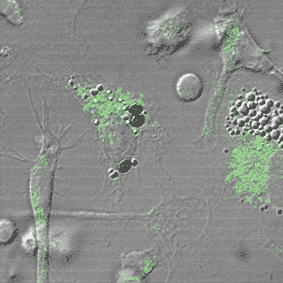
ELISA (capture) Immunohistochemistry (frozen sections, 1µg/ml) Suggested dilutions/conditions may not be available for all applications. Optimal conditions must be determined individually for each application.
Application Notes:
Excellent for ELISA (capture).
Formulation:
Liquid. In PBS containing 0.1% sodium azide.
Handling:
Avoid freeze/thaw cycles.
Shipping:
Blue Ice
Long Term Storage:
-20°C
Protocol:
Sandwich ELISA for PTX3
96 well-ELISA plates (Nunc MaxiSorp 446612) were coated with 100µl of MAb to PTX3 (human) (MNB4) (Prod. No. ALX-804-464), 1μg/ml in 100µl coating buffer (15mM carbonate buffer pH 9.6) and incubated overnight at 4°C.
After incubation, the plates were washed three times with 300µl/well of washing buffer (PBS + 0.05% Tween 20), and then 300µl of 5% dry milk in washing buffer were added to block non-specific binding.
The plates were incubated for 2 hours at room temperature and then washed three times with washing buffer.
50µl (in duplicate) recombinant human PTX3 standard (Prod. No. ALX-201-124) (75pg/ml to 2.4ng/ml ), cell supernatants or biological fluids diluted in PBS without Ca and Mg + 2% BSA were added and then incubated for 2 hours at 37°C.
The plates were washed five times with washing buffer, and then 100µl of PAb to PTX3 (human) (Biotin) (Prod. No. ALX-210-365B) 50ng/ml in washing buffer were added in each well.
The plates were incubated for 1 hour at 37°C and then washed five times with 300µl of washing buffer.
100 µl/well streptavidin-horseradish peroxidase diluted 1:4’000 were added and the plates incubated for 1 hour at room temperature.
After incubation the plates were washed 5 times with washing buffer and 100µl of TMB substrate solution was added to each well. After incubation for 10 min. at room-temperature, 50μl of stop-solution (1M H2SO4) was added. Subsequently, absorbance was read within 30min at 450nm.
Note: Do not use heparin plasma or serum samples with this assay. EDTA samples are recommended. The detection value in serum is generally less than in plasma samples.
Regulatory Status:
RUO - Research Use Only
Figure: Dendritic cells that phagocyte Aspergillus fumigatus stained with MAb to PTX3 (MNB4) (Prod. No. ALX-804-464)."
Please mouse over
Product Literature References
HC-HA/PTX3 from amniotic membrane reverts senescent limbal niche cells to Pax6+ neural crest progenitors to support limbal epithelial progenitors: S. Chen, et al.; Stem Cells 39, 280 (2021), Abstract; Full Text
Inhibition of Proliferation and Epithelial Mesenchymal Transition in Retinal Pigment Epithelial Cells by Heavy Chain-Hyaluronan/Pentraxin 3: H. He, et al.; Sci. Rep. 7, 43736 (2017), Abstract; Full Text
Pentraxin 3 Is Closely Associated With Tubulointerstitial Injury in Lupus Nephritis: A Large Multicenter Cross-Sectional Study: Y. Pang, et al.; Medicine (Baltimore) 95, e2520 (2016), Application(s): Used in ELISA measuring serum and urine concentrations of PTX3, Abstract; Full Text
Atorvastatin reduces long pentraxin 3 expression in vascular cells by inhibiting protein geranylgeranylation: R. Baetta, et al.; Vascul. Pharmacol. 67-69, 38 (2015), Application(s): Immunohistochemistry, Abstract;
Inflammation and thrombosis in essential thrombocythemia and polycythemia vera: different role of C-reactive protein and pentraxin 3: T. Barbui, et al.; Haematologica 96, 315 (2011), Abstract; Full Text
The Relationship Between Serum Pentraxin 3 and Central Obesity in ST-Segment Elevation Myocardial Infarction Patients: B.J. Shim, et al.; Korean Circ. J. 40, 308 (2010), Abstract; Full Text
Endogenous PTX3 translocates at the membrane of late apoptotic human neutrophils and is involved in their engulfment by macrophages: S. Jaillon, et al.; Cell Death Differ. 16, 465 (2009), Abstract;
Pentraxin 3 is elevated in haemodialysis patients and is associated with cardiovascular disease: M. Boehme, et al.; Nephrol. Dial. Transplant. 22, 2224 (2007), Abstract;
The humoral pattern recognition receptor PTX3 is stored in neutrophil granules and localizes in extracellular traps: S. Jaillon, et al.; J. Exp. Med. 204, 793 (2007), Abstract;
The long Pentraxin Ptx3 is synthesized in IgA glomerulonephritis and Activates Mesangial Cells: B. Bussolati, et al.; J. Immunol. 170, 1466 (2003), Abstract;
Production of the Long Pentraxin PTX3 in Advanced Atherosclerotic Plaques: M.S. Rolph, et al.; Arterioscler. Thromb. Vasc. Biol. 22, e10 (2002), Abstract;
PTX3, A Prototypical Long Pentraxin, is an Early Indicator of Acute Myocardial Infarction in Humans: G. Peri, et al.; Circulation 102, 636 (2000), Abstract; Full Text
Multimer formation and ligand recognition by the long pentraxin PTX3. Similarities and differences with the short pentraxins C-reactive protein and serum amyloid P component: B. Bottazzi, et al.; J. Biol. Chem. 272, 32817 (1997), Abstract;