Product Details
| Alternative Name: | CTNNB |
| |
| Clone: | 12F7 |
| |
| Host: | Mouse |
| |
| Isotype: | IgG1 |
| |
| Immunogen: | Recombinant β-catenin (N-terminal fragment). |
| |
| UniProt ID: | P35222 (human), Q02248 (mouse), Q9WU82 (rat) |
| |
| Species reactivity: | Human, Mouse, Rat
|
| |
| Applications: | IHC, IP, WB
|
| |
| Recommended Dilutions/Conditions: | Immunohistochemistry (1-5µg/ml)
Immunoprecipitation (2µg/200-300µl cell extract)
Western Blot (1µg/ml, ECL)
Suggested dilutions/conditions may not be available for all applications.
Optimal conditions must be determined individually for each application. |
| |
| Application Notes: | Detects bands of ~97kDa by Western blot. |
| |
| Purity Detail: | Protein A affinity purified. |
| |
| Formulation: | Liquid. In PBS, pH 7.2, containing 50% glycerol. |
| |
| Shipping: | Blue Ice |
| |
| Long Term Storage: | -20°C |
| |
| Scientific Background: | β-Catenin, a vertebrate homologue of Drosophila armadillo encoded by the CTNNB1 gene, performs two functions in the cell: mediating cell-cell adhesion by association between E-cadherin and the cytoskeleton, and acting as a downstream transcriptional activator of Wnt signaling, a key player in such functions as embryonic development, the induction of cell polarity, and the determination of cell fate. In the absence of Wnt signaling, glycogen synthase kinase-3β (GSK-3β) phosphorylates any free β-catenin at the amino terminus. This results in adenomatous polyposis coli tumor suppressor protein (APC)-mediated β-catenin degradation via the ubiquitin-proteosome pathway. Wnt signaling stabilizes β-catenin by inhibiting the activity of GSK-3β and preventing β-catenin degradation. β-catenin forms complexes with DNA-binding proteins such as T-cell factor (Tcf) and lymphocyte-enhancer factor (Lef), which promote expression of a variety of target genes, including c-myc and cyclin D1. |
| |
| Regulatory Status: | RUO - Research Use Only |
| |
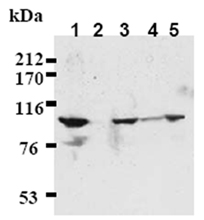
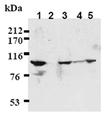
Western blot analysis of A431 cells (1), Hela cells (2), NIH/3T3 cells (3), C2C12 cells (4) and Rat-1 cells (5) probed with β-catenin mAb (12F7)
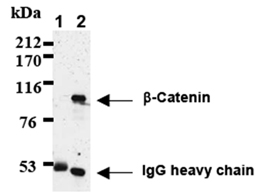
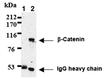
Immunoprecipitation of Rat-1 cells with normal mouse IgG (1) or β-catenin mAb (12F7 (2). After immunoprecipitated with the antibody, immunocomplex was resolved on SDS-PAGE and immunoblotted with β-catenin mAb (12F7).
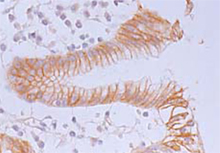
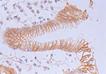
Immunohistochemical detection of gastric epithelium β-catenin on paraffin embedded sections with β-Catenin mAb (12F7).
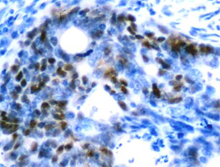
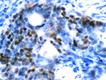
Immunohistochemical detection of colorectal cancer β-catenin on paraffin embedded sections with β-catenin mAb (12F7).
Please mouse over
Product Literature References
A high-throughput pipeline for validation of antibodies: K. Sikorski, et al.; Nat. Methods
15, 909 (2018),
Abstract;