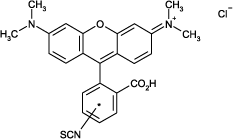
5(6)-TRITC is an amino-reactive labeling reagent that is widely used in preparing bioconjugates of proteins and nucleic acids. The resultant conjugates have similar spectral properties to those prepared from 5(6)-TAMRA, SE with improved stability. TRITC is widely used and has a multitude of applications beyond protein, peptide and nucleotide labeling For example, it can serve as an acceptor for FRET (Fluorescence Resonance Energy Transfer) based detection systems. FITC is recommended as a donor molecule in these FRET-based applications. Wavelength Maxima: Excitation 543nm, Emission 571nm
Product Details
| Alternative Name: | Tetramethylrhodamine-5(6)-isothiocyanate |
| |
| Formula: | C25H21N3O3S |
| |
| MW: | 480.0 |
| |
| CAS: | 95197-95-8 |
| |
| Purity: | ≥95% (HPLC) |
| |
| Solubility: | Soluble in DMSO. |
| |
| Shipping: | Ambient Temperature |
| |
| Long Term Storage: | -20°C |
| |
| Use/Stability: | Stable for at least one year after receipt when stored as recommended. |
| |
| Handling: | Protect from light. Keep cool and dry. |
| |
| Technical Info/Product Notes: | This product is a member of the CELLESTIAL® product line, reagents and assay kits comprising fluorescent molecular probes that have been extensively benchmarked for live cell analysis applications. CELLESTIAL® reagents and kits are optimal for use in demanding imaging applications, such as confocal microscopy, flow cytometry and HCS, where consistency and reproducibility are required. |
| |
| Regulatory Status: | RUO - Research Use Only |
| |
Please mouse over
Product Literature References
Polymeric nanoparticles for protein kinase activity: J.H. Kim, et al.; Chem. Commun. (Camb.)
2007, 1346 (2007),
Abstract;
Proximity relationships and structural dynamics of the phalloidin binding site of actin filaments in solution and on single actin filaments on heavy meromyosin: M. Heidecker, et al.; Biochemistry
34, 11017 (1995),
Abstract;