-
Directly monitor real time NO production in live cells by fluorescence microscopy
-
High specificity, sensitivity and accuracy, yielding a water-insoluble red fluorescent product
-
Distinguish between peroxynitrite and nitric oxide
-
NO inducer and scavenger included
Enzo Life Sciences’ NO Detection Kit is designed to directly monitor real time NO production in live cells by fluorescence microscopy using NO Detection Reagent (red fluorescent) as the major component. The non-fluorescent, cell-permeable NO detection dye reacts with NO in the presence of O2 with high specificity, sensitivity and accuracy, yielding a water-insoluble red fluorescent product. Importantly, this dye is not reactive towards peroxynitrite that allows distinguishing between peroxynitrite and nitric oxide.
The kit is not designed to detect reactive chlorine or bromine species, as the fluorescent probes included are relatively insensitive to these analytes. Upon staining, the fluorescent products generated by this dye can be visualized using a wide-field fluorescence microscope equipped with any red fluorescent cube. The combination of 650/670 nm is recommended when additional fluorescence signals (green or orange) would be detected simultaneously The NO Detection Kit contains sufficient reagents for at least 200 microscopy assays using live cells (adherent or in suspension).
Product Specification
| Application: | This kit is designed to directly monitor real time NO production in live cells using fluorescence microscopy. |
| |
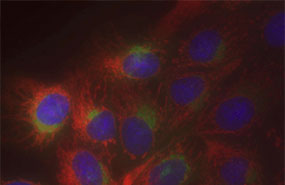
| Quality Control: | A sample from each lot of NO Detection Kit is used to stain HeLa cells using the procedures described in the user manual. The stained cells are analyzed using a wide-field fluorescence microscope equipped with standard red (650/670 nm) fluorescent cubes. The following results are obtained: - Nitric Oxide positive control samples induced with L-Arginine exhibit red fluorescence with a red punctuate cytoplasmic staining pattern - Cells incubated with the NO Scavenger (c-PTIO), post induced with L-Arginine don’t demonstrate any red fluorescence. |
| |
| Quantity: | 200 fluorescence microscopy assays. |
| |
| Handling: | Avoid freeze/thaw cycles. Protect from light. |
| |
| Short Term Storage: | -20°C |
| |
| Long Term Storage: | -80°C |
| |
| Kit/Set Contains: | NO Detection Reagent (Red), 60 µlNO Inducer (L-Arginine), 100 µl NO Scavenger (c-PTIO), 400 nmoles10X Wash Buffer, 15 ml |
| |
| Background / Technical Information: | The NO Detection Kit is a member of the CELLestial® product line, reagents and assay kits comprising fluorescent molecular probes that have been extensively benchmarked for live cell analysis applications. CELLestial® reagents and kits are optimal for use in demanding imaging applications, such as confocal microscopy, flow cytometry and HCS, where consistency and reproducibility are required. |
| |
General Literature References
Fluorescent and luminescent probes for measurement of oxidative and nitrosative species in cells and tissues: progress, pitfalls, and prospects: P. Wardman; Free Radic. Biol. Med.
43, 995 (2007),
Abstract;
Fluorescence probes used for detection of reactive oxygen species: A. Gomes, et al.; J. Biochem. Biophys. Methods
65, 45 (2005),
Abstract;
Determination of mitochondrial reactive oxygen species: methodological aspects: C. Batandier, et al.; J. Cell. Mol. Med.
6, 175 (2002),
Abstract;
Methods of detection of vascular reactive species: nitric oxide, superoxide, hydrogen peroxide, and peroxynitrite: M.M. Tarpey & I. Fridovich; Circ. Res.
89, 224 (2001),
Abstract;