-
Novel acidic organelle-selective dye, suitable for live cell imaging of lysosomes
-
Long wavelength red emission that is easily multiplexed with common fluorescent dyes (coumarin, FITC, Cyanine 3) and fluorescent proteins (BFP, CFP, GFP, YFP)
-
No photo conversion to a green emitting dye and no complicating metachromatic dual emission artifacts, facilitating analysis with GFP, FITC and other fluorescent probes
-
Highly resistant to photobleaching and concentration quenching, ensuring strong, consistent fluorescence signal, even after extended viewing periods
Lyso-ID
® Red Lysosomal Detection Kit (GFP-Certified
®) is an ideal choice for fluorescence co-localization imaging with GFP-tagged proteins, providing spectrally pure red signal. By contrast, many red-emitting lysosomal probes photoconvert to green fluorescent species or display metachromatic artifacts wherein emission occurs both in the red and green regions of the spectrum, leading to spurious results in GFP co-localization experiments [Freundt et al (2007) Cell Res.
17(11): 956- 958; Nadrigny et al (2007) Biophys J. 93(3):969-980]. The Lyso-ID
® Red Lysosomal Detection Kit (GFP-Certified
®)contains a proprietary acidic organelle-selective dye suitable for staining live cells. The dye is compatible with most fluorescence detection systems, including conventional and confocal fluorescence microscopes, as well as High Content Screening (HCS) platforms. This kit is specifically designed for use with GFP-expressing cell lines, as well as cells expressing blue, cyan or yellow fluorescent proteins (BFPs, CFPs, YFPs). The Lyso-ID
® Red dye has been validated for utility in live cell imaging applications, showing an appropriate response to treatment with well characterized lysosomal perturbation agents. A lysosome perturbation agent, chloroquine, is provided as a positive control for monitoring changes in lysosome number and volume. A nuclear counterstain (Hoechst 33342) is provided to highlight this organelle as well.
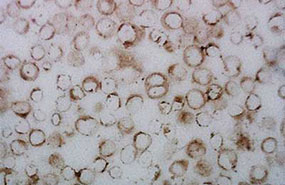
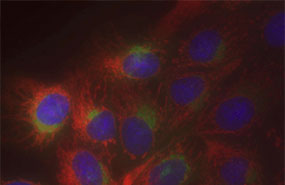
Figure 1: Composite bright-field and fluorescence microscopy images of control U2OS cells (left) and cells pre-treated with 64μM Chloroquine for 5 hours (right). Cells were stained with Lyso-ID® Red dye for 10 minutes. Nuclei were counter-stained with Hoechst 33342 dye.
Please mouse over
Product Specification
| Quantity: | 500 assays |
| |
| Quality Control: | 1. Absorption peak of Lyso-ID® Red Detection Reagent: λmax= 564 ± 9 nm 2. % purity of Lyso-ID® Red Detection Reagent by HPLC: ≥ 93% 3. A sample from each lot of GFP-Certified® Lyso-ID® Red Lysosomal Detection Kit is used to stain HeLa cells using the procedures described in the user manual. The stained cells exhibit dramatic increase in lysosome-like vesicle number and volume in the chloroquine-treated HeLa cells when analyzed by microscopy. |
| |
| Kit/Set Contains: | Lyso-ID® Red Detection Reagent, 50 µL
Hoechst 33342 Nuclear Staining, 50 µL
Chloroquine Control, 7.5 µmol
10X Assay Buffer, 15 mL |
| |
| Application: | For use with GFP-expressing cell lines, as well as cells expressing blue, cyan or yellow fluorescent proteins. |
| |
| Long Term Storage: | -80°C |
| |
| Use/Stability: | With proper storage, the kit components are stable up to the date noted on the product label. Store kit at -20°C in a non-frost free freezer, or –80°C for longer term storage. |
| |
| Handling: | Avoid freeze/thaw cycles. |
| |
| Background / Technical Information: |
The Lyso-ID® Red Lysosomal Detection Kit (GFP-Certified®) is a member of the CELLestial® product line, reagents and assay kits comprising fluorescent molecular probes that have been extensively benchmarked for live cell analysis applications. CELLestial® reagents and kits are optimal for use in demanding imaging applications, such as confocal microscopy, flow cytometry and HCS, where consistency and reproducibility are required. |
| |