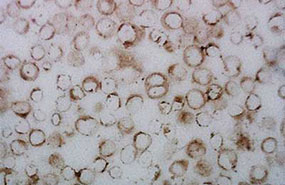
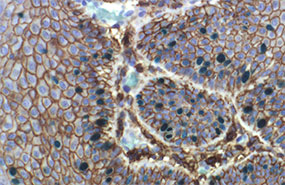
The hybridoma secreting the MAb to Mono- and Polyubiquitinylated Conjugates (FK2) (Prod. No. BML-PW8805) was generated by fusion of splenocytes from Balb/c mice which had received repeated immunisation with a crude preparation of polyubiquitinylated-lysozyme. MAb to Mono- and Polyubiquitinylated Conjugates (FK2) has been extensively characterised by one-dimensional Western blotting and has been shown to recognise K29-, K48-, and K63-linked polyubiquitinylated and monoubiquitinylated proteins but not free ubiquitin.
Product Specification
| Clone: | FK2 |
| |
| Host: | Mouse |
| |
| Isotype: | IgG1 |
| |
| Immunogen: | Poly-ubiquitinylated lysozyme. |
| |
| Application: | ELISA
Immunohistochemistry
Immunoprecipitation (Care must be taken as MAb to Mono- and Polyubiquitinylated Conjugates (FK2) demonstrates affinity for both free ubiquitin and multi-ubiquitinylated species when immobilised)
Western Blot (1:100-1:1000)
Optimal conditions must be determined individually for each application. |
| |
| Specificity: | Recognizes mono- and polyubiquitinylated conjugates. Species independent. Does not cross-react with free ubiquitin. |
| |
| Purity Detail: | Purified. |
| |
| Formulation: | Liquid. In PBS containing 0.1% sodium azide. |
| |
| Handling: | Avoid freeze/thaw cycles. Store unopened vial at -20°C until required for use. Store diluted antibody at 2-4°C and use within 1 month. |
| |
| Long Term Storage: | -20°C |
| |
Figure 1: Western blot of multi-ubiquitin chains using MAb to Polyubiquitinylated Conjugates (FK1) (Prod. No. BML-PW8805) (lanes A-C) and MAb to Mono- and Polyubiquitinylated Conjugates (FK2) (Prod. No. BML-PW8810) (lanes D-F).
Lanes A & D: K48-linked chains.Lanes B & E: K49-linked chains. Lanes C & F: K63-linked chains.
Please mouse over
Product Literature References
Autophagy inhibition promotes defective neosynthesized proteins storage in ALIS, and induces redirection toward proteasome processing and MHCI-restricted presentation: T. Wenger et al; Autophagy
8, 350 (2012),
Abstract;
Heterologous SUMO-2/3-Ubiquitin Chains Optimize IκBα Degradation and NF-κB Activity: F. Aillet, et al.; PLoS One
7, e51672 (2012),
Abstract;
Full Text
The proteasomal de-ubiquitinating enzyme POH1 promotes the double-strand DNA break response: L.R. Butler et al; EMBO
31, 3918 (2012),
Abstract;
Loss of hrs in the central nervous system causes accumulation of ubiquitinated proteins and neurodegeneration: K. Tamai, et al.; Am. J. Pathol.
173, 1806 (2008),
Abstract;
Large-scale analysis of the human ubiquitin-related proteome : Matsumoto, M. et al. ; Proteomics
5, 4145 (2005),
Abstract;
Chemotropic responses of retinal growth cones mediated by rapid local protein synthesis and degradation: D.S. Campbell et al.; Neuron
32, 1013 (2001),
Abstract;
Isolation of ubiquitin-E2 (ubiquitin conjugating enzyme complexes from erythroleukaemia cells using immunoaffinity techniques: K. Takada et al.; Biochem. J.
356, 199 (2001),
Abstract;
Full Text
MHC Class I ubiquitination by a viral PHD/LAP finger protein: J.N. Boname et al.; Immunity
15, 627 (2001),
Abstract;
Dynamics of ubiquitin conjugation during heat-shock response revealed by using a monoclonal antibody specific to multi-ubiquitin chains: M. Fujimuro, et al.; Eur. J. Biochem.
249, 427 (1997),
Abstract;
Serum concentrations of free ubiquitin and multiubiquitin chains: K. Takada et al.; Clin. Chem.
43, 1188 (1997),
Abstract;
Full Text
Immunoassay for the quantification of intracellular multi-ubiquitin chains: K. Takada, et al.; Eur. J. Biochem.
233, 42 (1995),
Abstract;
Production and characterization of monoclonal antibodies specific to multi-ubiquitin chains of polyubiquitinated proteins: M. Fujimuro, et al.; FEBS Lett.
349, 173 (1994),
Abstract;