Replaces Prod. #: ALX-350-254
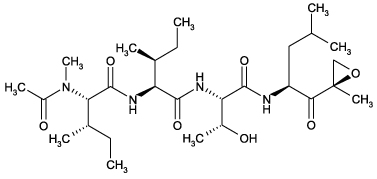
Cell permeable, potent and selective proteasome inhibitor originally isolated from Actinomycetes strain based on its potent in vivo antitumor activity. More potent inhibitor of the chymotrypsin-like activity of the proteasome than lactacystin (Prod. No. BML-PI104). Blocks also trypsin-like and PGPH activities of the proteasome. Regulates antigen presentation at non-toxic doses. Effectively inhibits NF-κB activation in vitro and potently blocks inflammation in vivo in the mouse ear edema assay.The ubiquitin-proteasome system (UPS) and autophagy serve as two complementary, reciprocally regulated protein degradation systems, thus blockade of UPS by Epoxomicin activates autophagy.
Product Details
| Formula: | C28H50N4O7 |
| |
| MW: | 554.7 |
| |
| CAS: | 134381-21-8 |
| |
| MI: | 14: 3630 |
| |
| Purity: | ≥95% (HPLC) |
| |
| Appearance: | Lyophilized. Very thin transparent film. |
| |
| Solubility: | Soluble in DMSO (15mg/ml) or dichloromethane:methanol (9:1); insoluble in water. |
| |
| Shipping: | Blue Ice |
| |
| Long Term Storage: | -20°C |
| |
| Use/Stability: | Stable for at least 1 year after receipt when stored, as supplied, at -20°C. Stock solutions are stable for up to 3 months at -20°C. |
| |
| Handling: | Protect from light. Avoid freeze/thaw cycles. |
| |
| Regulatory Status: | RUO - Research Use Only |
| |
Please mouse over
Product Literature References
Proteasome activator 28γ (PA28γ) allosterically activates trypsin-like proteolysis by binding to the α-ring of the 20S proteasome: T.A. Thomas & D.M. Smith; J. Biol. Chem.
298, 102140 (2022),
Abstract;
Archaeal Connectase is a specific and efficient protein ligase related to proteasome β subunits: A.C.D. Fuchs, et al.; PNAS
118, 2017871118 (2021),
Abstract;
Early-onset impairment of the ubiquitin-proteasome system in dopaminergic neurons caused by α-synuclein: C. McKinnon, et al.; Acta Neuropathol. Commun.
8, 17 (2020),
Abstract;
Full Text
Nogo-A interacts with TrkA to alter nerve growth factor signaling in Nogo-A-overexpressing PC12 cells: R.G. Farrer, et al.; Cell. Signal.
44, 20 (2018),
Abstract;
Caspase vinyl sulfone small molecule inhibitors prevent axonal degeneration in human neurons and reverse cognitive impairment in Caspase-6-overexpressing mice: P. Pakavathjkumar, et al.; Mol. Neurodegener.
12, 22 (2017),
Abstract;
Full Text
Comparative Proteomics Reveals Strain-Specific β-TrCP Degradation via Rotavirus NSP1 Hijacking a Host Cullin-3-Rbx1 Complex: S. Ding, et al.; PLoS Pathology
12, e1005929 (2016),
Application(s): Cell treatment,
Abstract;
Full Text
Prion-mediated neurodegeneration is associated with early impairment of the ubiquitin-proteasome system: C. McKinnon, et al.; Acta Neuropathol.
131, 411 (2016),
Application(s): Determined background activity caused by non-proteasomal degradation,
Abstract;
Full Text
Bortezomib Amplifies Effect on Intracellular Proteasomes by Changing Proteasome Structure: D.S. Pitcher, et al.; EBioMedicine
2, 642 (2015),
Application(s): Western Blot,
Abstract;
The regulation of glucose on milk fat synthesis is mediated by the ubiquitin-proteasome system in bovine mammary epithelial cells: L. Liu, et al.; Biochem. Biophys. Res. Commun.
465, 59 (2015),
Application(s): Cell culture,
Abstract;
The small heat shock protein B8 (HSPB8) confers resistance to bortezomib by promoting autophagic removal of misfolded proteins in multiple myeloma cells: M. Hamouda, et al.; Oncotarget
5, 6252 (2014),
Application(s): Analysis of velcade resistant multiple myeloma human cells by WB, Assay,
Abstract;
Full Text
Pathogen signatures activate a ubiquitination pathway that modulates the function of the metabolic checkpoint kinase mTOR: S. Ivanov & C. Roy; Nat. Immunol.
14, 1219 (2013),
Application(s): Analysis of mouse macrophages by WB, PCR,
Abstract;
Full Text
Removal of damaged proteins during ES cell fate specification requires the proteasome activator PA28: M. Hernebring, et al.; Sci. Rep.
3, 1381 (2013),
Abstract;
Full Text
Protein carbonylation and aggregation precede neuronal apoptosis induced by partial glutathione depletion: A. Dasgupta, et al.; ASN Neuro
4, e00084 (2012),
Abstract;
Full Text
Novel Cell- and Tissue-Based Assays for Detecting Misfolded and Aggregated Protein Accumulation Within Aggresomes and Inclusion Bodies: D. Shen, et al.; Cell Biochem. Biophys.
60, 173 (2011),
Abstract;
Full Text
Role of autophagy and proteasome degradation pathways in apoptosis of PC12 cells overexpressing human alpha-synuclein: F. Yang, et al.; Neurosci. Lett.
454, 203 (2009),
Abstract;
Establishment and some characteristics of epoxomicin (a proteasome inhibitor) resistant variants of the human squamous cell carcinoma cell line, A431: K. Ohkawa, et al.; Int. J. Oncol.
24, 425 (2004),
Abstract;
The selective proteasome inhibitors lactacystin and epoxomicin can be used to either up- or down-regulate antigen presentation at nontoxic doses: K. Schwarz, et al.; J. Immunol.
164, 6147 (2000),
Abstract;
Epoxomicin, a potent and selective proteasome inhibitor, exhibits in vivo antiinflammatory activity: L. Meng, et al.; PNAS
96, 10403 (1999),
Abstract;
Proteasome inhibition by the natural products epoxomicin and dihydroeponemycin: insights into specificity and potency: K.B. Kim, et al.; Bioorg. Med. Chem. Lett.
9, 3335 (1999),
Abstract;
Total synthesis of the potent proteasome inhibitor epoxomicin: a useful tool for understanding proteasome biology: N. Sin, et al.; Bioorg. Med. Chem. Lett.
9, 2283 (1999),
Abstract;
Epoxomicin, a new antitumor agent of microbial origin: M. Hanada, et al.; J. Antibiot. (Tokyo)
45, 1746 (1992),
Abstract;
Related Products