Product Details
| Alternative Name: | APO-1L, CD95L, CD178, TNFSF 6 |
| |
| MW: | ~32kDa (non-glycosylated), ~35kDa (glycosylated) (SDS-PAGE). |
| |
| Source: | Produced in HEK 293 cells. The extracellular domain of human FasL (APO-1L; CD95L; CD178) (aa 103-281) is fused at the N-terminus to a linker peptide (26 aa) and a FLAG®-tag. Glycosylation of rhsFasL is similar to that of natural human FasL. |
| |
| UniProt ID: | P48023 |
| |
| Concentration: | 0.1mg/ml after reconstitution. |
| |
| Formulation: | Lyophilized. Contains PBS. |
| |
| Purity: | ≥95% (SDS-PAGE) |
| |
| Purity Detail: | Purified by multi-step chromatography. |
| |
| Endotoxin Content: | <0.1EU/µg purified protein (LAL test; Associates of Cape Cod). |
| |
| Species reactivity: | Human, Mouse, Rat
|
| |
| Specificity: | Binds to human, mouse and rat Fas (CD95; APO-1). |
| |
| Biological Activity: | Kills Jurkat cells in the absence of a cross-linker. Cross-linking enhancer (see Set Prod. No. ALX-850-014) increases the activity of rhsFasL approx. 50-fold.
Attention: Results using sFasL may differ from those obtained with agonistic antibodies! |
| |
| Applications: | ELISA
|
| |
| Application Notes: | ELISA: binds to Fas receptor at 1-100 ng/ml. |
| |
| Reconstitution: | Reconstitute with 100µl sterile water. Further dilutions should be made with medium containing 5% fetal calf serum. |
| |
| Shipping: | Blue Ice |
| |
| Long Term Storage: | -20°C |
| |
| Use/Stability: | Stable for at least 6 months after receipt when stored at -20°C. |
| |
| Handling: | Avoid freeze/thaw cycles. After reconstitution, prepare aliquots and store at -20°C. |
| |
| Technical Info/Product Notes: | Historical lots have shown that FasL kills Jurkat cells at concentrations of >10ng/ml in the absence of a cross-linker. Historical lots have also shown an ED50 of 50ng/ml (A20 cells). |
| |
| Regulatory Status: | RUO - Research Use Only |
| |
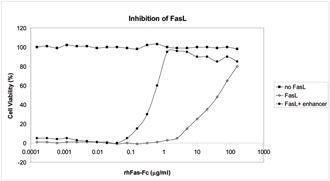
Activity Assay analysis: Inhibition of FasL, Soluble (human) (rec.) (Prod. No. ALX-522-001)-mediated lysis. Fas (human):Fc (human) (rec.) (Prod. No. ALX-522-002) exerts its inhibitory activity in a concentration range of 0.5-5μg/ml in the presence of the enhancer (1μg/ml).
Please mouse over
Product Literature References
Quantifying requirements for mitochondrial apoptosis in CAR T killing of cancer cells: A.L. Pourzia, et al.; Cell Death Dis.
14, 267 (2023),
Abstract;
Mitochondrial reactive oxygen is critical for IL-12/IL-18-induced IFN-γ production by CD4+ T cells and is regulated by Fas/FasL signaling: G. Rackov, et al.; Cell Death Dis.
13, 531 (2022),
Abstract;
The non-apoptotic function of Caspase-8 in negatively regulating the CDK9-mediated Ser2 phosphorylation of RNA polymerase II in cervical cancer: R. Mandal, et al.; Cell. Mol. Life Sci.
79, 597 (2022),
Abstract;
Fas-FasL interaction in cytotoxic T cell-mediated vitiligo: The role of lesional expression of tumor necrosis factor-α and interferon-γ in Fas-mediated melanocyte apoptosis: H. Jimbo, et al.; Exp. Dermatol.
29, 61 (2020),
Abstract;
Tumor Suppressor Death-Associated Protein Kinase 1 Inhibits Necroptosis by p38 MAPK Activation: Y. Wu, et al.; Cell Death Dis.
11, 305 (2020),
Abstract;
Full Text
Fas activation alters tight junction proteins in acute lung injury: R. Herrero, et al.; Thorax
74, 69 (2019),
Abstract;
Flagellin increases death receptor-mediated cell death in a RIP1-dependent manner: D. Hancz, et al.; Immunol. Lett.
193, 42 (2018),
Abstract;
Pevonedistat, a Nedd8-activating enzyme inhibitor, sensitizes neoplastic B-cells to death receptor-mediated apoptosis: C. Paiva, et al.; Oncotarget
8, 21128 (2017),
Abstract;
Full Text
Attenuation of lung fibrosis in mice with a clinically relevant inhibitor of glutathione-S-transferase: D.H. McMillan, et al.; JCI Insight
1, e85717 (2016),
Abstract;
Full Text
Regulation of PERK-eIF2α signalling by tuberous sclerosis complex-1 controls homoeostasis and survival of myelinating oligodendrocytes: M. Jiang, et al.; Nat. Commun.
7, 12185 (2016),
Abstract;
Full Text
Id3 Controls Cell Death of 2B4+ Virus-Specific CD8+ T Cells in Chronic Viral Infection: A.J. Menner, et al.; J. Immunol.
195, 2103 (2015),
Abstract;
Glycogen synthase kinase-3 beta regulates Snail and β-catenin expression during Fas-induced epithelial-mesenchymal transition in gastrointestinal cancer: H. Zheng, et al.; Eur. J. Cancer
49, 2734 (2013),
Abstract;
Role of the cell cycle in regression of the corpus luteum: S.M. Quirk, et al.; Reproduction
145, 161 (2013),
Application(s): Death induction of bovine luteal cells,
Abstract;
Full Text
The Fas/FasL pathway impairs the alveolar fluid clearance in mouse lungs: R. Herrero, et al.; Am. J. Physiol. Lung Cell Mol. Physiol.
305, L377 (2013),
Application(s): Death induction of primary mouse alveolar epithelial and endothelial cells,
Abstract;
The soluble Decoy Receptor 3 is regulated by a PI3K-dependent mechanism and promotes migration and invasion in renal cell carcinoma: D. Weissinger, et al.; Mol. Cancer
12, 120 (2013),
Abstract;
Full Text
A novel TNFR1-triggered apoptosis pathway mediated by class IA PI3Ks in neutrophils: B. Geering, et al.; Blood
117, 5953 (2011),
Application(s): Death induction of murine bone marrow neutrophils,
Abstract;
Full Text
Different Signaling Pathways Stimulate a Disintegrin and Metalloprotease-17 (ADAM17) in Neutrophils during Apoptosis and Activation: Y. Wang, et al.; J. Biol. Chem.
286, 38980 (2011),
Application(s): Death induction of Jurkat cells,
Abstract;
Full Text
Notochordal cells protect nucleus pulposus cells from degradation and apoptosis: implications for the mechanisms of intervertebral disc degeneration: W.M. Erwin, et al.; Arthritis Res. Ther.
13, R215 (2011),
Abstract;
Full Text
CD40·FasL and CTLA-4·FasL fusion proteins induce apoptosis in malignant cell lines by dual signaling: A. Orbach, et al.; Am. J. Pathol.
177, 3159 (2010),
Abstract;
Full Text
Primary and malignant cholangiocytes undergo CD40 mediated Fas dependent apoptosis, but are insensitive to direct activation with exogenous Fas ligand: E.H. Humphreys, et al.; PLoS One
5, e14037 (2010),
Abstract;
Full Text
A role for cFLIP in B cell proliferation and stress MAPK regulation: H. Zhang, et al.; J. Immunol.
182, 207 (2009),
Abstract;
Full Text
Redox amplification of apoptosis by caspase-dependent cleavage of glutaredoxin 1 and S-glutathionylation of Fas: V. Anathy, et al.; J. Cell Biol.
184, 241 (2009),
Application(s): Death induction of C10 cells, Fibroblasts and CD4+ T lymphocytes,
Abstract;
Full Text
Caspase-8 Cleaves Histone Deacetylase 7 and Abolishes Its Transcription Repressor Function: F.L. Scott, et al.; J. Biol. Chem.
283, 19499 (2008),
Application(s): Death induction of primary mouse thymocytes,
Abstract;
Full Text
Loss of the BH3-only protein Bmf impairs B cell homeostasis and accelerates gamma irradiation-induced thymic lymphoma development: V. Labi, et al.; J. Exp. Med.
205, 641 (2008),
Abstract;
Full Text
CD4-Dependent Signaling Is Required for a Late Checkpoint during Th2 Development Associated with Resistance to Activation-Induced Cell Death: Z. Tatari-Calderone, et al.; J. Immunol.
175, 5629 (2005),
Application(s): Death induction of murine T cells,
Abstract;
Full Text
Cytoskeleton-mediated death receptor and ligand concentration in lipid rafts forms apoptosis-promoting clusters in cancer chemotherapy: C. Gajate & F. Mollinedo; J. Biol. Chem.
280, 11641 (2005),
Abstract;
Full Text
Cathepsin-B-dependent apoptosis triggered by antithymocyte globulins: a novel mechanism of T-cell depletion: M. C. Michallet, et al.; Blood
102, 3719 (2004),
Abstract;
The anti-apoptotic factor Bcl-2 can functionally substitute for the B cell survival but not for the marginal zone B cell differentiation activity of BAFF: A. Tardivel, et al.; Eur. J. Immunol.
34, 509 (2004),
Abstract;
A second step of chemotaxis after transendothelial migration: keratinocytes undergoing apoptosis release IFN-gamma-inducible protein 10, monokine induced by IFN-gamma, and IFN-gamma-inducible alpha-chemoattractant for T cell chemotaxis toward epidermis in: S. Klunker, et al.; J. Immunol.
171, 1078 (2003),
Abstract;
Full Text
Theileria parva-Transformed T Cells Show Enhanced Resistance to Fas/Fas Ligand-Induced Apoptosis : P. Küenzi, et al.; J. Immunol.
171, 1224 (2003),
Application(s): Death induction of Theileria parva-infected TpM(803) T cells,
Abstract;
Full Text
BCR engagement induces Fas resistance in primary B cells in the absence of functional Bruton's tyrosine kinase: J.R. Tumang, et al.; J. Immunol.
168, 2712 (2002),
Abstract;
Hepatic natural killer cells exclusively kill splenic/blood natural killer-resistant tumor cells by the perforin/granzyme pathway: D. Vermijlen, et al.; J. Leukoc. Biol.
72, 668 (2002),
Application(s): Death induction of P815 cells,
Abstract;
Full Text
Fas ligand overexpression on allograft endothelium inhibits inflammatory cell infiltration and transplant-associated intimal hyperplasia: M. Sata, et al.; J. Immunol.
166, 6964 (2001),
Abstract;
Fas-associated death domain protein (FADD) and caspase-8 mediate up-regulation of c-Fos by Fas ligand and tumor necrosis factor-related apoptosis-inducing ligand (TRAIL) via a FLICE inhibitory protein (FLIP)-regulated pathway: D. Siegmund, et al.; J. Biol. Chem.
276, 32585 (2001),
Abstract;
Full Text
Mechanisms underlying neuronal death induced by chromogranin A-activated microglia: J. Ciesielski-Treska, et al.; J. Biol. Chem.
276, 13113 (2001),
Abstract;
Full Text
T cell costimulation by the TNF ligand BAFF: B. Huard, et al.; J. Immunol.
167, 6225 (2001),
Abstract;
Crosstalk Between Keratinocytes and T Lymphocytes via Fas/Fas Ligand Interaction: Modulation by Cytokines: R. Arnold, et al.; J. Immunol.
162, 7140 (1999),
Application(s): Death induction of Jurkat cells,
Abstract;
Full Text
Fas-Mediated Suicide of Tumor-Reactive T Cells Following Activation by Specific Tumor: Selective Rescue by Caspase Inhibition: T.Z. Zaks, et al.; J. Immunol.
162, 3273 (1999),
Application(s): Death induction of tumor-specific CD8+ T cells,
Abstract;
Full Text
Inhibition of Toxic Epidermal Necrolysis by Blockade of CD95 with Human Intravenous Immunoglobulin: I. Viard, et al.; Science
282, 490 (1998),
Application(s): Death induction of human keratinocytes,
Abstract;
Agonist antibody and Fas ligand mediate different sensitivity to death in the signaling pathways of Fas and cytoplasmic mutants: A.R. Thilenius, et al.; Eur. J. Immunol.
27, 1108 (1997),
Abstract;
Characterization of Fas (Apo-1, CD95)-Fas ligand interaction: P. Schneider, et al.; J. Biol. Chem.
272, 18827 (1997),
Abstract;
Full Text
Related Products