Cited in several environment-related research articles
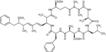
Microcystin-LF (MC-LF) is an analog of microcystin-LR (Prod. No. ALX-350-012) with Phe substituted in place of Arg. MC-LF is hydrophobic and more cell permeable than other microcystins. This increased cell permeability can be useful for biochemical studies in intact cells. MC-LF is more toxic than more hydrophilic analogs such as microcystin-LR (Prod. No. ALX-350-012) or microcystin-LY (Prod. No. ALX-350-148).
Product Details
Alternative Name:
MC-LF
Formula:
C52H71N7O12
MW:
986.2
Source:
Isolated from Microcystis aeruginosa.
CAS:
154037-70-4
Purity:
≥95% (HPLC)
Identity:
Identity determined by MS.
Appearance:
Whitish film adhered to inside of the vial.
Solubility:
Soluble in 100% methanol.
Shipping:
Ambient Temperature
Long Term Storage:
-20°C
Use/Stability:
Stable in solution for at least 4 weeks when stored at -20 °C.
Handling:
For maximum product recovery after thawing, centrifuge the vial before opening the cap.
Scientific Background:
Cyanobacteria are photosynthetic prokaryotes mostly present in freshwater ecosystems. The increasingly frequent appearance of cyanobacteria blooms in lakes and rivers is linked to climate changes and human activities. Microcystins are a group of cyclic heptapeptide hepatotoxins produced by a number of cyanobacterial genera. The most notable of which, and namesake, is the widespread genus Microcystis. Structurally, all microcystins consist of the generalized structure cyclo(-D-Ala1-X2-D-MeAsp3-Y4-Adda5-D-Glu6-Mdha7-). X and Y are variable L-amino acids, D-MeAsp is D-erythro-β-methylaspartic acid and Mdha is N-methyldehydroalanine. Adda is the cyanobacteria unique C20 β-amino acid 3-amino-9-methoxy-2,6,8-trimethyl-10-phenyl-deca-4,6-dienoic acid. Substitutions of the variable L-amino acids at positions 2 and 4 give rise to at least 21 known primary microcystin analogs and alterations in the other constituent amino acids result in more than 90 reported mycrocystins to date.
Regulatory Status:
RUO - Research Use Only
Please mouse over
Product Literature References
Novel one-point calibration strategy for high-throughput quantitation of microcystins in freshwater using LC-MS/MS: H. Zhang, et al.; Sci. Total Environ. 858, 159345 (2023), Abstract;
Year-Round Presence of Microcystins and Toxin-Producing Microcystis in the Water Column and Ice Cover of a Eutrophic Lake Located in the Continuous Permafrost Zone (Yakutia, Russia): V. Gabyshev, et al.; Toxins 15, 467 (2023), Abstract;
7-epi-cylindrospermopsin and microcystin producers among diverse Anabaena/Dolichospermum/Aphanizomenon CyanoHABs in Oregon, USA: T.W. Dreher, et al.; Harmful Algae 116, 102241 (2022), Abstract;
A Feasibility Study into the Production of a Mussel Matrix Reference Material for the Cyanobacterial Toxins Microcystins and Nodularins: A.D. Turner, et al.; Toxins 15, 27 (2022), Abstract;
A Summer of Cyanobacterial Blooms in Belgian Waterbodies: Microcystin Quantification and Molecular Characterizations: W.H.R. Van Hassel, et al.; Toxins 14, 61 (2022), Abstract;
Adsorption of cyanotoxins on polypropylene and polyethylene terephthalate: Microplastics as vector of eight microcystin analogues: D.S. Moura, et al.; Environ. Pollut. 303, 119135 (2022), Abstract;
Confirmation Using Triple Quadrupole and High-Resolution Mass Spectrometry of a Fatal Canine Neurotoxicosis following Exposure to Anatoxins at an Inland Reservoir: A.D. Turner, et al.; Toxins 14, 804 (2022), Abstract;
Identification of Novel Microcystins Using High-Resolution MS and MSn with Python Code: D. Baliu-Rodriguez, et al.; Environ. Sci. Technol. 56, 1652 (2022), Abstract;
Improving the Quantification of Cyanotoxins Using a Mass Balance-Based Effective Concentration-Equivalent Concentration Approach: A. Jia, et al.; Environ. Sci. Technol. 56, 14418 (2022), Abstract;
LC-MS/MS Validation and Quantification of Cyanotoxins in Algal Food Supplements from the Belgium Market and Their Molecular Origins: W.H.R. Van Hassel, et al.; Toxins 14, 513 (2022), Abstract;
An ELISA-based Method for Variant-independent Detection of Total 3 Microcystins and Nodularins via Multi-immunogen Approach: J. Liu, et al.; Environ. Sci. Technol. 55, 12984 (2021), Abstract;
Comparison of UV-A photolytic and UV/TiO 2 photocatalytic effects on Microcystis aeruginosa PCC7813 and four microcystin analogues: A pilot scale study: I. Menezes, et al.; J. Environ. Manage. 298, 113519 (2021), Abstract;
Degradation of Multiple Peptides by Microcystin-Degrader Paucibacter toxinivorans (2C20): A.A. Santos, et al.; Toxins (Basel) 13, 265 (2021), Abstract; Full Text
Remediation Strategies to Control Toxic Cyanobacterial Blooms: Effects of Macrophyte Aqueous Extracts on Microcystis aeruginosa (Growth, Toxin Production and Oxidative Stress Response) and on Bacterial Ectoenzymatic Activities: Z. Tazart, et al.; Microorganisms 9, 1782 (2021), Abstract;
Ecotoxicological profiling of selected cyanobacterial strains using multi-endpoint effect-directed analysis: P. Marić, et al.; Ecotoxicology 29, 535 (2020), Application(s): Used as standards, Abstract;
Exposure to aerosolized algal toxins in South Florida increases short- and long-term health risk in Drosophila model of aging: J. Hu, et al.; Toxins 12, 787 (2020), Abstract; Full Text
Machine Learning Prediction of Cyanobacterial Toxin (Microcystin) Toxicodynamics in Humans: S. Altaner, et al.; ALTEX 37, 24 (2020), Abstract;
Microcystin Toxins at Potentially Hazardous Levels in Algal Dietary Supplements Revealed by a Combination of Bioassay, Immunoassay, and Mass Spectrometric Methods: T. Miller, et al.; J. Agric. Food Chem. 68, 8016 (2020), Abstract; Full Text
Microcystins and Microcystis aeruginosa PCC7806 extracts modulate steroidogenesis differentially in the human H295R adrenal model: V. Mallia, et al.; PLoS One 15, 12 (2020), Abstract; Full Text
Dhb Microcystins Discovered in USA Using an Online Concentration LC-MS/MS Platform: J.A. Birbeck, et al.; Toxins (Basel) 11, 653 (2019), Abstract; Full Text
An Innovative Portable Biosensor System for the Rapid Detection of Freshwater Cyanobacterial Algal Bloom Toxins: S.R. Bickman, et al.; Environ. Sci. Technol. 52, 11691 (2018), Abstract;
First observation of microcystin- and anatoxin-a-producing cyanobacteria in the easternmost part of the Gulf of Finland (the Baltic Sea): E. Chernova, et al.; Toxion 157, 18 (2018), Abstract;
Are We Underestimating Benthic Cyanotoxins? Extensive Sampling Results from Spain: E. A. Cantoral Uriza, et al.; Toxins (Basel) 9, 385 (2017), Abstract; Full Text
Simple, high efficiency detection of microcystins and nodularin-R in water by fluorescence polarization immunoassay: H. Zhang, et al.; Anal. Chim. Acta 992, 119 (2017), Abstract;
Effect of chlorination on the protein phosphatase inhibition activity for several microcystins: H. Mash, et al.; Water Res. 95, 230 (2016), Abstract;
Hepatotoxic Microcystin Removal Using Pumice Embedded Monolithic Composite Cryogel as an Alternative Water Treatment Method: F. Gurbuz, et al.; Water Res. 90, 337 (2016), Application(s): Injection, Abstract;
Selective cytotoxicity of microcystins LR, LW and LF in rat astrocytes: K. Bulc Rozman, et al.; Toxicol. Lett. 15, 1 (2016), Abstract;
Biodegradation of multiple microcystins and cylindrospermopsin in clarifier sludge and a drinking water source: Effects of particulate attached bacteria and phycocyanin: E. Maghsoudi, et al.; Ecotoxicol. Environ. Saf. 120, 409 (2015), Abstract;
Investigation of microcystin congener-dependent uptake into primary murine neurons: D. Feurstein, et al.; Environ. Health Perspect. 118, 1370 (2010), Abstract; Full Text
The role of organic anion transporting polypeptides (OATPs/SLCOs) in the toxicity of different microcystin congeners in vitro: a comparison of primary human hepatocytes and OATP-transfected HEK293 cells: A. Fischer, et al.; Toxicol. Appl. Pharmacol. 245, 9 (2010), Abstract;
Pseudodiarrhoea in zebra mussels Dreissena polymorpha (Pallas) exposed to microcystins: G. Juhel, et al.; J. Exp. Biol. 209, 810 (2006), Abstract;
Detection and quantification of microcystins (cyanobacterial hepatotoxins) with recombinant antibody fragments isolated from a naive human phage display library: J. McElhiney, et al.; FEMS Microbiol. Lett. 193, 83 (2000), Abstract;
Comparative toxicity of four microcystins of different hydrophobicities to the protozoan, Tetrahymena pyriformis: C.J. Ward & G.A. Codd; J. Appl. Microbiol. 86, 874 (1999), Abstract;
Isolation and characterization of microcystins from laboratory cultures and environmental samples of Microcystis aeruginosa and from an associated animal toxicosis: L.A. Lawton, et al.; Nat. Toxins 3, 50 (1995), Abstract;
Extraction and high-performance liquid chromatographic method for the determination of microcystins in raw and treated waters: L.A. Lawton, et al.; Analyst 119, 1525 (1994), Abstract;
First report of microcystins from a Brazilian isolate of the cyanobacterium Microcystis aeruginosa: S.M.F.O. Azevedo, et al.; J. Appl. Phycol. 6, 261 (1994),