Highly pure okadaic acid isolated from marine dinoflagellates
Potent inhibitor of protein phosphatase 1 and protein phosphatase 2A
Useful for the study of cellular processes regulated by phosphorylation
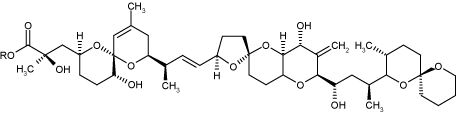
Okadaic acid is a naturally occuring polyether toxin produced by marine dinoflagellates. It is a potent and selective inhibitor of protein phosphatases, inhibiting PP2A completely at 1nM and PP1 at higher concentrations (IC50=10-15nM). PP2B is much less sensitive to okadaic acid than PP1, while PP2C is not inhibited. This selectivity is the basis for an improved identification and quantification procedure for these enzymes. The hydrophobic backbone of okadaic acid enables it to enter cells where it stimulates intracellular protein phosphorylation. It mimics the effects of insulin, enhances transmitter release at neuromuscular junctions, and causes vasodilation. Okadaic acid is an extremely useful tool for studying cellular processes that are regulated by phosphorylation. It does not affect activity of acid phosphatase, alkaline phosphatase, or tyrosine phosphatase. It induces apoptosis in human breast carcinoma cells (MB-231 and MCF-7) and in myeloid cells, but inhibits glucocorticoid-induced apoptosis in T cell hybridomas. It is a non-phorbol type of tumor promoter. It has shown contractile effects on smooth muscle and heart muscle. It significantly increases cyclin B1 expression in adult neurons.
Product Details
Alternative Name:
Halochondrine A, 9,10-Deepithio-9,10-didehydroacanthifolicin
Formula:
C44H68O13
MW:
805.0
Source:
Isolated from Prorocentrum Sp.
CAS:
78111-17-8
MI:
14: 6819
RTECS:
AA8227800
Purity:
≥98% (HPLC, TLC)
Appearance:
White crystalline solid.
Solubility:
Soluble in DMSO (40 mg/ml), 100% ethanol (5 mg/ml), and 100% methanol.
Shipping:
Ambient Temperature
Long Term Storage:
-20°C
Use/Stability:
Use only fresh solutions.
Handling:
Protect from light. Packaged under inert gas.
Technical Info/Product Notes:
Replacement for ADI-HPK-117
Regulatory Status:
RUO - Research Use Only
R = H: Okadaic acid (Prod. No. ALX-350-003)
R = ONH4: ammonium salt (Prod. No. ALX-350-010)
R = OK: potassium salt (Prod. No. ALX-350-063)
R = ONa: sodium salt (Prod. No. ALX-350-011)
Please mouse over
Product Literature References
Okadaic Acid Activates JAK/STAT Signaling to Affect Xenobiotic Metabolism in HepaRG Cells: L.T.D. Wuerger, et al.; Cells 12, 770 (2023), Abstract;
C-peptide promotes cell migration by controlling matrix metallopeptidase-9 activity through direct regulation of β-catenin in human endometrial stromal cells: S.A. Khaliq, et al.; Front. Cell Dev. Biol. 10, 800181 (2022), Abstract; Full Text
Chemogenetic profiling reveals PP2A-independent cytotoxicity of proposed PP2A activators iHAP1 and DT-061: G. Vit, et al.; EMBO J. 41, e110611 (2022), Abstract;
Valproic acid decreases vascular smooth muscle cell proliferation via protein phosphatase 2A-mediated p70 S6 kinase inhibition: H. Lee , et al.; Biochem. Biophys. Res. Commun. 606, 94 (2022), Abstract;
Phosphatase PP2A enhances MCL-1 protein half-life in multiple myeloma cells: A. Slomp, et al.; Cell Death Dis. 12, 229 (2021), Abstract; Full Text
Nitration of protein phosphatase 2A increases via Epac1/PLCε/CaMKII/HDAC5/iNOS cascade in human endometrial stromal cell decidualization: S.Y. Lee, et al.; FASEB J. 34, 14407 (2020), Abstract;
Ordered dephosphorylation initiated by the selective proteolysis of cyclin B drives mitotic exit: J. Holder, et al.; Elife 9, e59885 (2020), Abstract; Full Text
Liver disease–associated keratin 8 and 18 mutations modulate keratin acetylation and methylation: K. Jang, et al.; FASEB J. 33, 9030 (2019), Abstract; Full Text
Measuring the kinase activities of the LATS/NDR protein kinases: A. Hergovich.; Methods Mol. Biol. 1893, 305 (2019), Abstract;
Nemo-like kinase drives Foxp3 stability and is critical for maintenance of immune tolerance by regulatory T cells: V. Fleskens, et al.; Cell Rep. 26, 3600 (2019), Abstract; Full Text
Oxidative stress promotes SIRT1 recruitment to the GADD34/PP1α complex to activate its deacetylase function: I.C. Lee, et al.; Cell Death. Differ. 25, 255 (2018), Abstract; Full Text
Pathological missorting of endogenous MAPT/Tau in neurons caused by failure of protein degradation systems: V. Balaji, et al.; Autophagy 14, 2139 (2018), Abstract; Full Text
Metabolism of okadaic acid by NADPH-dependent enzymes present in human or rat liver S9 fractions results in different toxic effects: F. Kolrep, et al.; Toxicol. In Vitro. 42, 161 (2017), Abstract;
Lipocalin 2 produces insulin resistance and can be upregulated by glucocorticoids in human adipose tissue: P.G. Kamble, et al.; Mol. Cell. Endrocrinol. 427, 124 (2016), Application(s): Immunoblotting analysis of adipose tissue, Abstract;
Protein Phosphatase 1 Beta is Modulated by Chronic Hypoxia and Involved in the Angiogenic Endothelial Cell Migration: D. Iacobazzi, et al.; Cell. Physiol. Biochem. 36, 384 (2015), Application(s): Cell Culture, Migration Assay, Abstract; Full Text
Regulation of autophagy by coordinated action of mTORC1 and protein phosphatase 2A: P.M. Wong, et al.; Nat. Commun. 6, 8048 (2015), Application(s): Western Blot, Cell Culture, Abstract; Full Text
Retinoic Acid Modulates Interferon-γ Production by Hepatic Natural Killer T Cells via Phosphatase 2A and the Extracellular Signal-Regulated Kinase Pathway: H.K. Chang, et al.; J. Interferon Cytokine Res. 35, 200 (2015), Abstract; Full Text
A receptor-interacting protein 1 (RIP1)-independent necrotic death under the control of protein phosphatase PP2A that involves the reorganization of actin cytoskeleton and the action of cofilin-1: A. Tomasella, et al.; J. Biol. Chem. 289, 25699 (2014), Abstract;
Dephosphorylation of CCAAT/enhancer-binding protein β by protein phosphatase 2A containing B56δ is required at the early time of adipogenesis: M. Park, et al.; Biochim. Biophys. Acta 1841, 1608 (2014), Abstract;
hMOB3 modulates MST1 apoptotic signaling and supports tumor growth in glioblastoma multiforme: F. Tang, et al.; Cancer Res. 74, 3779 (2014), Abstract; Full Text
PP2A inhibitors suppress migration and growth of PANC-1 pancreatic cancer cells through inhibition on the Wnt/β-catenin pathway by phosphorylation and degradation of β-catenin: M.Y. Wu, et al.; Oncol Rep. 32, 513 (2014), Abstract; Full Text
Effect of okadaic acid on cultured clam heart cells: involvement of MAPkinase pathways: H. Hanana, et al.; Biol. Open 15, 1192 (2012), Abstract; Full Text
Establishment of functional primary cultures of heart cells from the clam Ruditapes decussatus: H. Hanana, et al.; Cytotechnology 63, 295 (2011), Abstract; Full Text
Synaptic activity and nuclear calcium signaling protect hippocampal neurons from death signal-associated nuclear translocation of FoxO3a induced by extrasynaptic N-methyl-D-aspartate receptors: O. Dick, et al.; J. Biol. Chem. 285, 19354 (2010), Abstract; Full Text
Okadaic acid induced cyclin B1 expression and mitotic catastrophe in rat cortex: B. Chen, et al.; Neurosci. Lett. 406, 178 (2006), Abstract;
Mechanism of Ca2+-mediated regulation of NDR protein kinase through autophosphorylation and phosphorylation by an upstream kinase: R. Tamaskovic, et al.; J. Biol. Chem. 278, 6710 (2003), Abstract; Full Text
Unique features of the okadaic acid activity class of tumor promoters: H. Fujiki & M. Suganuma; J. Cancer Res. Clin. Oncol. 125, 150 (1999), Review, Abstract;
Differential inhibition and posttranslational modification of protein phosphatase 1 and 2A in MCF7 cells treated with calyculin-A, okadaic acid, and tautomycin: B. Favre et al.; J. Biol. Chem. 272, 13856 (1997), Abstract;
Differential induction of apoptosis in human breast tumor cells by okadaic acid and related inhibitors of protein phosphatases 1 and 2A: K. Kiguchi, et al.; Cell Growth Differ. 5, 995 (1994), Abstract;
Multiple apoptotic death types triggered through activation of separate pathways by cAMP and inhibitors of protein phosphatases in one (IPC leukemia) cell line: B.T. Gjertsen, et al.; J. Cell. Sci. 107, 3363 (1994), Abstract;
Okadaic acid inhibits glucocorticoid-induced apoptosis in T cell hybridomas at its late stage: Y. Ohoka, et al.; BBRC 197, 916 (1993), Abstract;
Inhibition of apoptosis in human tumour cells by okadaic acid: Q. Song, et al.; J. Cell Physiol. 153, 550 (1992), Abstract;
Nonphorbol tumor promoters okadaic acid and calyculin-A induce membrane translocation of protein kinase C: R. Gopalakrishna, et al.; BBRC 189, 950 (1992), Abstract;
Okadaic acid enhances human T cell activation and phosphorylation of an internal substrate induced by phorbol myristate acetate: Y. Tada, et al.; Immunopharmacol. 24, 17 (1992), Abstract;
Protein phosphatase inhibitors okadaic acid and calyculin A alter cell shape and F-actin distribution and inhibit stimulus-dependent increases in cytoskeletal actin of human neutrophils: P. Kreienbuehl, et al.; Blood 80, 2911 (1992), Abstract;
Site-specific dephosphorylation of smooth muscle myosin light chain kinase by protein phosphatases 1 and 2A: M. Nomura, et al.; Biochemistry 31, 11915 (1992), Abstract;
Use of okadaic acid to inhibit protein phosphatases in intact cells: D.G. Hardie et al.; Methods. Enzymol. 201, 469 (1991), Abstract;
Characterization of microcystin-LR, a potent inhibitor of type 1 and type 2A protein phosphatases: R.e. Honkanen et al.; J. Biol. Chem. 265, 19401 (1990), Abstract;
Okadaic acid: a new probe for the study of cellular regulation: P. Cohen, et al.; TIPS 15, 98 (1990), (Review), Abstract;
An improved procedure for identifying and quantitating protein phosphatases in mammalian tissues: P. Cohen et al.; FEBS Lett. 250, 596 (1989), Abstract;
Effects of the tumour promoter okadaic acid on intracellular protein phosphorylation and metabolism: T.A. Haystead, et al.; Nature 337, 78 (1989), Abstract;
Protein phosphatases come of age: P. Cohen & P.T.W. Cohen; J. Biol. Chem. 264, 21435 (1989), Abstract; Full Text
The structure and regulation of protein phosphatases: P. Cohen; Ann. Rev. Biochem. 58, 453 (1989), Abstract;
Inhibitory effect of a marine-sponge toxin, okadaic acid, on protein phosphatases. Specificity and kinetics: C. Bialojan & A. Takai; Biochem. J. 256, 283 (1988), Abstract;
Okadaic acid: an additional non-phorbol-12-tetradecanoate-13-acetate- type tumor promoter: M. Suganuma, et al.; PNAS 85, 1768 (1988), Abstract;
155716-06-6, Isolated from Prorocentrum concavum by preparative flash, medium pressure and high performance liquid chromatography. Salt form generated in aqueous ammonium hydroxide-methanol solution., ≥98% (TLC) | Print as PDF
155751-72-7, Isolated from Prorocentrum concavum by preparative flash, medium pressure and high performance liquid chromatography. Salt form generated in aqueous potassium hydroxide-methanol solution., ≥98% (HPLC) | Print as PDF