Product Details
| Alternative Name: | HSP75, Mitochondrial HSP90, MtHSP90 |
| |
| Recommended Dilutions/Conditions: | Western Blot (100ng, colorimetric)
Suggested dilutions/conditions may not be available for all applications.
Optimal conditions must be determined individually for each application. |
| |
| MW: | ~72kDa |
| |
| Source: | Produced in E. coli. Human TRAP1 (aa 60-704) is fused at the N-terminus to a His-tag. |
| |
| UniProt ID: | Q12931 |
| |
| Formulation: | Liquid. In 50mM TRIS, pH 7.5, containing 150mM sodium chloride, 1mM DTT, and 1mM EDTA. |
| |
| Purity: | ≥95% (SDS-PAGE; Western blot) |
| |
| Purity Detail: | Purified by multi-step chromatography. |
| |
| Endotoxin Content: | <50EU/mg purified protein (LAL test) |
| |
| Applications: | WB
|
| |
| Application Notes: | Western blot control. |
| |
| Shipping: | Dry Ice |
| |
| Long Term Storage: | -80°C |
| |
| Scientific Background: | The Hsp90 family of heat shock proteins represents one of the most abundantly expressed and highly conserved families of cellular chaperones whose expression can be upregulated under conditions of cellular stress. It includes cytoplasmic (Hsp90-alpha/beta), ER (Grp94) and mitochondrial (TRAP1) localized members. Hsp90 is structurally composed of an N-terminal ATP binding domain, a medial substrate-binding region, and a C-terminal dimerization motif. Hsp90 dimers function in cooperation with cochaperones to stabilize a multitude of client proteins substrates. TRAP1 (aka Hsp75) was originally identified as a chaperone binding partner for retinoblastoma protein. TRAP1 was later found by immunofluorescence to be localized to the mitochondria. TRAP1 is significantly more active as an ATPase due in part to the lack of regulatory elements in the C-terminus, but retains the ability to dimerize. However, it does not form stable complexes with typical cochaperones of Hsp90 like p23 and HOP4. TRAP1 has been identified as a protective element for cell survival, and has been suggested as a target for anti-cancer therapeutics. |
| |
| Regulatory Status: | RUO - Research Use Only |
| |
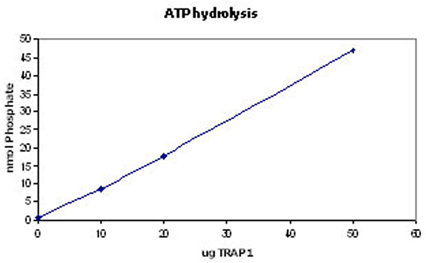
ATPase Assay: ATP hydrolysis after 1 hour at 37oC detected by malachite green. Quantities determined by comparison to potassium phosphate standard. Approximate activity is 1.2 nmol PO4/nmol TRAP1/min.
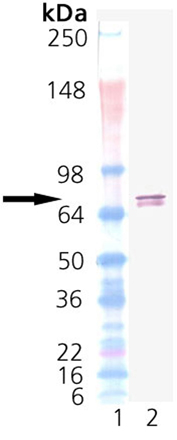
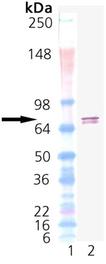
Western Blot analysis: Lane 1: MWM, Lane 2: TRAP1, probed with TRAP1 mAb.
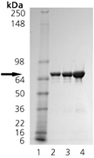
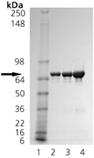
SDS-PAGE analysis: Lane 1: MW marker, Lane 2: 1µg, Lane 3: 2µg, Lane 4: 5µg TRAP1 protein
Please mouse over
Product Literature References
Protein allostery and ligand design: Computational design meets experiments to discover novel chemical probes: A. Triveri, et al.; J. Mol. Biol.
434, 167468 (2022),
Abstract;
S-nitrosylation of the Mitochondrial Chaperone TRAP1 Sensitizes Hepatocellular Carcinoma Cells to Inhibitors of Succinate Dehydrogenase: S. Rizza, et al.; Cancer Res.
76, 4170 (2016),
Abstract;
Structure-activity relationship in a purine-scaffold compound series with selectivity for the endoplasmic reticulum Hsp90 paralog Grp94: H.J. Patel, et al.; J. Med. Chem.
58, 3922 (2015),
Abstract;
Full Text
Experimental and structural testing module to analyze paralogue-specificity and affinity in the Hsp90 inhibitors series: T. Taldone, et al.; J. Med. Chem.
56, 6803 (2013),
Abstract;
Full Text
Paralog-selective Hsp90 inhibitors define tumor-specific regulation of HER2: P.D. Patel, et al.; Nat. Chem. Biol.
9, 677 (2013),
Abstract;
Full Text
Related Products