-
Sensitive – measure as little as 65.57 pg/ml of NBR1
-
Quantitative – fully quantitative results surpass semi-quantitative Western blot analysis
-
Higher Throughput – assay up to 38 samples in duplicate in just 2 hours
-
Easy-to-use – liquid color-coded reagents reduce errors
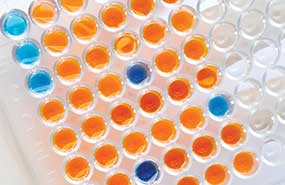
The NBR1 ELISA kit is a colorimetric, immunometric immunoassay kit with results in 2 hours.
Inhibition of Macroautophagy: Human HeLa cells were treated with 800 nM Bafilomycin A1, an inhibitor of Autophagy protein degradation, for 24 hours at 37°C. Treated and untreated cells were washed in PBS and lysed in RIPA Cell Lysis Buffer 2 (Catalog No. ADI‐80‐1284) with protease inhibitors. Treated and untreated lysate dilutions (1:2, 1:4, 1:8, 1:16, 1:32, and 1:64) were run on a 4‐15% Tris‐HCl gradient gel. Proteins were then transferred to a nitrocellulose membrane and probed with a monoclonal antibody against NBR1. The same lysates were also diluted in the assay buffer and run in this kit.
Correlation of p62 (Prod. No. ADI-900-212) and NBR1 (Prod. No. ADI-900-211) immunoassays to autophagy induction. MDA-MB-231 human breast cancer cells were treated with 2μM of withaferin A (WA), an autophagy inducing drug. Cells were harvested at 6, 12 and 24 hours post-treatment and lysed in RIPA cell lysis buffer 2 containing protease inhibitors and DNase. Cell lysates were clarified by centrifugation and analyzed in p62 assay (Figure 3A) and NBR1 assay (Figure 3B). Concentration of antigen was normalized to total cellular protein. Cell lysates were resolved by SDS-PAGE and analyzed by Western blot using anti-p62 antibody from Cell Signaling, CN #5114 (Figure 3C) or anti-LC3 antibody from Cell Signaling, CN #2775 (Figure 3D). Signal intensity in both Western blots were compared to actin levels and numbers above band represent changes in protein levels relative to corresponding DMSO-treated control.
Please mouse over
Product Specification
| Alternative Name: | Neighbor of BRCA1 gene 1 |
| |
| Sensitivity: | 65.57pg/ml (range 125 - 8000pg/ml) |
| |
| Assay Time: | 2 hours |
| |
| Application: | For the quantitative determination of human, rat and mouse NBR1 in cell lysate samples. |
| |
| Crossreactivity: | No cross reactivity. |
| |
| Use/Stability: | Store all components at -20ºC. |
| |
| Long Term Storage: | -20°C |
| |
| Kit/Set Contains: | Microtiter Plate, Antibody, Assay Buffer 13, Wash Buffer Concentrate, Standard, TMB Substrate, Stop Solution 2, RIPA Cell Lysis Buffer 2 |
| |
| Miscellaneous/General: | The generic term ‘‘autophagy’’ comprises several processes by which the lysosome acquires cytosolic cargo, with three types of autophagy being discerned in the literature: (1) macroautophagy, characterized by the formation of a crescent-shaped structure (the phagophore) that expands to form the double-membrane autophagosome, capable of fusion with the lysosome; (2) microautophagy, in which lysosomes invaginate and directly sequester cytosolic components; and (3) chaperone-mediated autophagy (CMA), which involves translocation of unfolded proteins across the lysosomal membrane.
Upregulation of autophagy pathways occurs in response to extra- or intracellular stress and signals such as starvation, growth factor deprivation, ER stress and pathogen infection. Malfunction of these pathways is linked to various human pathologies including cancer, neurodegeneration and infectious diseases.
Selective macroautophagy describes the pathway of self-degradation of whole cellular components, protein aggregates or unusually long-lived proteins; in which double-membrane autophagosomes sequester organelles, ubiquitinylated proteins or ubiquitinylated protein aggregates and subsequently fuse with lysosomes for breakdown by resident hydrolases. Autophagic clearance of protein aggregates requires the ubiquitin-binding receptors p62 and NBR1.
NBR1 (neighbor of BRCA1 gene 1), a 966-amino acid long protein, is a selective (macro)autophagy substrate that interacts with mono- and poly-ubiquitin conjugates (K63 and K48-linked) via its UBA domain, and LC3/GABARAP via its LIR domain. NBR1 and p62 share very similar domain organizations; the PB1 (Phox and Bem1) domain of NBR1 can bind to the PB1 domain of p62, where it either adds to the polymeric p62 chain or becomes the chain terminus. In spite of the similarities between the two, p62 and NBR1 do not require each other for functionality. NBR1 has been detected in Ub- and p62-positive Mallory bodies in patients with alcoholic steatohepatitus and has been implicated as a potential biomarker for certain hereditary muscle diseases and various proteinopathies involving accumulation of misfolded proteins. NBR1 has also been shown to be a negative regulator of postnatal osteoblastic bone formation and p38 MAPK activity. |
| |